
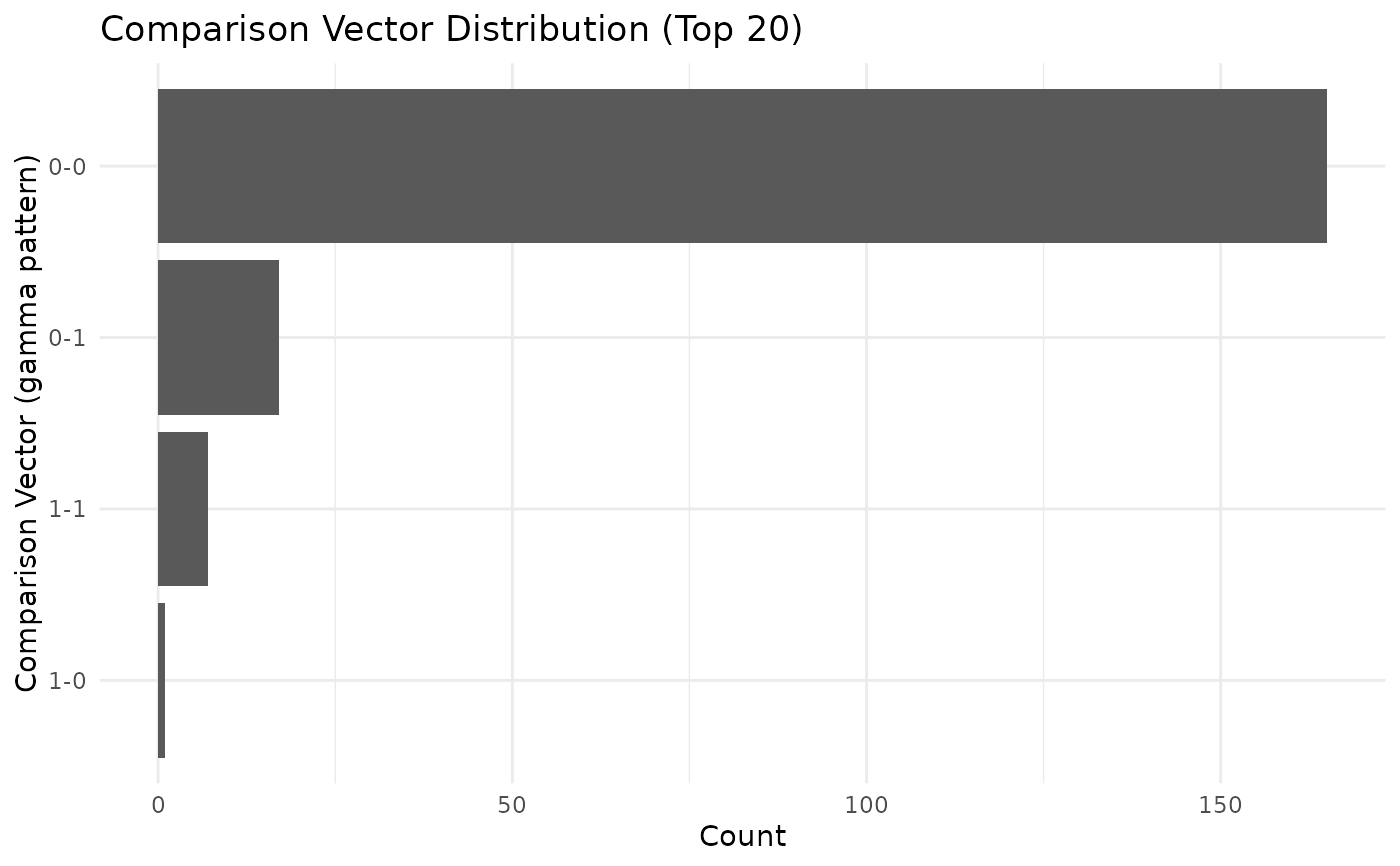
Computes the distribution of gamma patterns (agreement vectors) across record pairs. Each unique combination of gamma values across comparisons is a "comparison vector". This function counts how often each pattern occurs.
Arguments
- model
A trained
il_model.- blocking
A blocking rule created by
block_on(). IfNULL, uses all blocking rules from the model spec.- limit
Maximum number of pairs to sample. Defaults to
NULL(all pairs).
Value
A tibble::tibble() with one row per unique comparison vector and
columns gamma_<col> for each comparison plus count (number
of pairs with that pattern) and proportion. Class
il_comparison_vectors.
Examples
con <- DBI::dbConnect(duckdb::duckdb())
#> duckdb keeps downloaded extensions and secrets in a temporary directory:
#> ℹ /tmp/RtmpAun1I8/duckdb
#> This is removed when the R session ends.
#> • Extensions are re-downloaded each session.
#> • Secrets are lost.
#> ℹ Run duckdb(shared_home = TRUE) (or create ~/.duckdb) to keep them (suitable for most users).
#> ℹ Run duckdb(shared_home = FALSE) to accept the temporary directory (and silence this message).
#> ℹ See ?duckdb_storage for details and alternatives.
spec <- il_spec() |>
il_compare(first_name, cl_exact()) |>
il_compare(surname, cl_exact())
model <- il_model(fake_20, spec = spec, con = con)
vectors <- il_comparison_vectors(model)
ggplot2::autoplot(vectors)
 il_cleanup(model)
DBI::dbDisconnect(con, shutdown = TRUE)
il_cleanup(model)
DBI::dbDisconnect(con, shutdown = TRUE)