
This vignette reproduces the Splink
“Linking banking transactions” demo in irelink. It
demonstrates two-table linkage with link_type = "link" by
matching each outgoing payment in the origin table to the corresponding
incoming payment in the destination table.
The data is synthetic and intentionally challenging. Amounts differ
because of fees and exchange-rate effects, dates can shift by a few
days, and memos are sometimes truncated. Because each origin payment has
exactly one destination counterpart, the prior match probability is
1 / n_origin.
This vignette requires nanoparquet to
read the remote Parquet files, and it only compiles when the package and
both data URLs are available. It also assumes DuckDB because the
blocking rules below use raw .where SQL with DuckDB date
helpers such as strftime() and yearweek().
Load the data
library(irelink)
#>
#> Attaching package: 'irelink'
#> The following object is masked from 'package:base':
#>
#>     months
library(ggplot2)

df_origin
#> # A data frame: 45,326 × 5
#>    ground_truth memo            transaction_date  amount unique_id
#>           <dbl> <chr>           <date>             <dbl>     <dbl>
#>  1            0 MATTHIAS C paym 2022-03-28          36.4         0
#>  2            1 M CORVINUS dona 2022-02-14         222.          1
#>  3            2 M C donation BG 2022-05-04         450.          2
#>  4            3 M C BGC         2022-03-03         208.          3
#>  5            4 M CORVINUS  CSH 2022-02-04          79.7         4
#>  6            5 M C  WRE        2022-03-26         835.          5
#>  7            6 M CORVINUS CSH  2022-05-01          66.7         6
#>  8            7 M C 1b097ab5 CH 2022-03-15       26246.          7
#>  9            8 M C  WRE        2022-03-26          92.8         8
#> 10            9 M C payment CHQ 2022-05-04         211.          9
#> # ℹ 45,316 more rows
df_destination
#> # A data frame: 45,326 × 5
#>    ground_truth memo                     transaction_date  amount unique_id
#>           <dbl> <chr>                    <date>             <dbl>     <dbl>
#>  1            0 "MATTHIAS C payment BGC" 2022-03-29          36.4         0
#>  2            1 "M CORVINUS BGC"         2022-02-16         222.          1
#>  3            2 "M C"                    2022-05-05         450.          2
#>  4            3 "M C payment"            2022-03-04         199.          3
#>  5            4 "M CORVINUS "            2022-02-05          79.7         4
#>  6            5 "M C "                   2022-03-27         835.          5
#>  7            6 "M CORVINUS dona"        2022-05-05          66.7         6
#>  8            7 "M C CHQ"                2022-03-27       25908.          7
#>  9            8 "M C  WRE"               2022-03-27          91.9         8
#> 10            9 "M C payment CHQ"        2022-05-17         212.          9
#> # ℹ 45,316 more rows
Profile the data
il_profile(df_origin, memo, transaction_date, amount, con = con, top_n = 8)
#> # A tibble: 24 × 3
#>    column           value               n
#>    <chr>            <chr>           <dbl>
#>  1 memo             J B payment BGC    27
#>  2 memo             J B donation BG    25
#>  3 memo             J B money BGC      24
#>  4 memo             J B  BGC           21
#>  5 memo             J S money BGC      18
#>  6 memo             J P  BGC           18
#>  7 memo             A B money BGC      18
#>  8 memo             J C money BGC      17
#>  9 transaction_date 19122             696
#> 10 transaction_date 19119             693
#> # ℹ 14 more rows
Choose blocking rules
Because corresponding records differ in predictable ways, the
blocking rules need to be broad enough to retain true matches while
still shrinking the search space. Fees change amounts, dates shift, and
memos are truncated, so the rules below use SQL expressions in
.where rather than relying on exact agreement alone:
counts <- il_count_pairs(
  df_origin,
  df_destination,
  # Same year-month, similar memo prefix, amount ratio within 30%
  block_on(
    .where = paste(
      "strftime(l.transaction_date, '%Y%m') = strftime(r.transaction_date, '%Y%m')",
      'AND substr(l.memo, 1, 3) = substr(r.memo, 1, 3)',
      'AND l.amount / r.amount > 0.7 AND l.amount / r.amount < 1.3'
    )
  ),
  # Same but offset by 15 days to catch month boundaries
  block_on(
    .where = paste(
      "strftime(l.transaction_date + 15, '%Y%m') = strftime(r.transaction_date, '%Y%m')",
      'AND substr(l.memo, 1, 3) = substr(r.memo, 1, 3)',
      'AND l.amount / r.amount > 0.7 AND l.amount / r.amount < 1.3'
    )
  ),
  # Memo prefix (first 9 characters)
  block_on(.where = 'substr(l.memo, 1, 9) = substr(r.memo, 1, 9)'),
  # Rounded amount + same week
  block_on(
    .where = paste(
      'round(l.amount / 2, 0) * 2 = round(r.amount / 2, 0) * 2',
      'AND yearweek(r.transaction_date) = yearweek(l.transaction_date)'
    )
  ),
  # Amount offset + week offset
  block_on(
    .where = paste(
      'round(l.amount / 2, 0) * 2 = round((r.amount + 1) / 2, 0) * 2',
      'AND yearweek(r.transaction_date) = yearweek(l.transaction_date + 4)'
    )
  ),
  # Ground-truth "cheat" rule for completeness
  block_on(unique_id),
  con = con,
  link_type = 'link'
)
counts
#> # A tibble: 6 × 4
#>   rule                                 n_pairs cumulative_pairs pct_of_cartesian
#>   <chr>                                  <dbl>            <dbl>            <dbl>
#> 1 strftime(l.transaction_date, '%Y%m'…  301614           301614           0.0147
#> 2 strftime(l.transaction_date + 15, '…  281675           428250           0.0208
#> 3 substr(l.memo, 1, 9) = substr(r.mem…  330510           710190           0.0346
#> 4 round(l.amount / 2, 0) * 2 = round(…  353563          1051372           0.0512
#> 5 round(l.amount / 2, 0) * 2 = round(…  352877          1321538           0.0643
#> 6 unique_id                              45326          1321565           0.0643
autoplot(counts)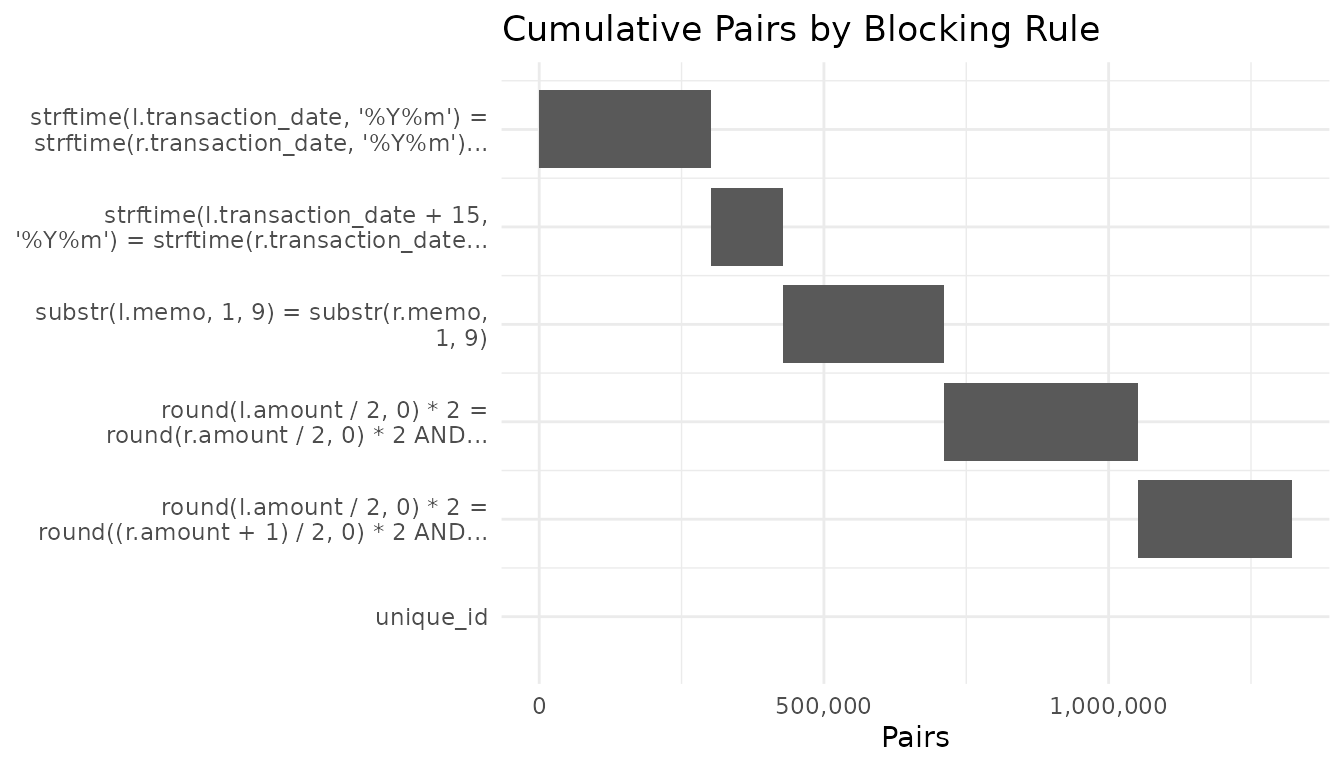
Define the specification
The transaction_date comparison is one-sided because a
payment can only arrive after it is sent. The comparison therefore
checks whether destination_date - origin_date is between 0
and N days:
spec <- il_spec() |>
  il_compare(amount, cl_pct_diff(0.01, 0.03, 0.10, 0.30)) |>
  il_compare(memo, cl_levenshtein(2, 6, 10)) |>
  il_compare(
    transaction_date,
    cl_levels(
      cl_null(),
      cl_custom('(r.{col} - l.{col}) BETWEEN 0 AND 1'),
      cl_custom('(r.{col} - l.{col}) BETWEEN 0 AND 4'),
      cl_custom('(r.{col} - l.{col}) BETWEEN 0 AND 10'),
      cl_custom('(r.{col} - l.{col}) BETWEEN 0 AND 30'),
      cl_else()
    )
  ) |>
  il_block_on(
    .where = paste(
      "strftime(l.transaction_date, '%Y%m') = strftime(r.transaction_date, '%Y%m')",
      'AND substr(l.memo, 1, 3) = substr(r.memo, 1, 3)',
      'AND l.amount / r.amount > 0.7 AND l.amount / r.amount < 1.3'
    )
  ) |>
  il_block_on(
    .where = paste(
      "strftime(l.transaction_date + 15, '%Y%m') = strftime(r.transaction_date, '%Y%m')",
      'AND substr(l.memo, 1, 3) = substr(r.memo, 1, 3)',
      'AND l.amount / r.amount > 0.7 AND l.amount / r.amount < 1.3'
    )
  ) |>
  il_block_on(.where = 'substr(l.memo, 1, 9) = substr(r.memo, 1, 9)') |>
  il_block_on(
    .where = paste(
      'round(l.amount / 2, 0) * 2 = round(r.amount / 2, 0) * 2',
      'AND yearweek(r.transaction_date) = yearweek(l.transaction_date)'
    )
  ) |>
  il_block_on(
    .where = paste(
      'round(l.amount / 2, 0) * 2 = round((r.amount + 1) / 2, 0) * 2',
      'AND yearweek(r.transaction_date) = yearweek(l.transaction_date + 4)'
    )
  ) |>
  il_block_on(unique_id)

spec
#> Linkage Specification
#>   Comparisons (3):
#>     amount : pct_diff
#>     memo : levenshtein
#>     transaction_date : levels
#>   Blocking rules (6, OR-ed):
#>     1. WHERE strftime(l.transaction_date, '%Y%m') = strftime(r.transaction_date, '%Y%m') AND substr(l.memo, 1, 3) = substr(r.memo, 1, 3) AND l.amount / r.amount > 0.7 AND l.amount / r.amount < 1.3
#>     2. WHERE strftime(l.transaction_date + 15, '%Y%m') = strftime(r.transaction_date, '%Y%m') AND substr(l.memo, 1, 3) = substr(r.memo, 1, 3) AND l.amount / r.amount > 0.7 AND l.amount / r.amount < 1.3
#>     3. WHERE substr(l.memo, 1, 9) = substr(r.memo, 1, 9)
#>     4. WHERE round(l.amount / 2, 0) * 2 = round(r.amount / 2, 0) * 2 AND yearweek(r.transaction_date) = yearweek(l.transaction_date)
#>     5. WHERE round(l.amount / 2, 0) * 2 = round((r.amount + 1) / 2, 0) * 2 AND yearweek(r.transaction_date) = yearweek(l.transaction_date + 4)
#>     6. unique_id
Train the model
Because this benchmark is one-to-one, set the prevalence prior
directly with il_prior_prevalence() instead of changing
model$params by hand:
model <- il_model(
  df_origin,
  df_destination,
  spec = spec,
  con = con,
  link_type = 'link'
)
model <- il_prior_prevalence(model, 1 / nrow(df_origin))
model <- il_estimate_u(model, max_pairs = 1e6) |>
  il_estimate_em(block_on(memo)) |>
  il_estimate_em(block_on(amount))
#> EM trained: amount and transaction_date | skipped (blocked on): memo
#> EM trained: memo and transaction_date | skipped (blocked on): amount
Inspect the trained model
summary(model)
#> irelink Model
#>   Status: Trained
#>   Link type: link
#>   Records: 45326
#>   Records (right): 45326
#>   Comparisons: 3
#>   Blocking rules: 6
#>
#>   Parameters:
#>     prior: 0.003558299
#>     priors: # A tibble: 1 × 5
#>      priors:   family     comparison gamma_level probability strength
#>      priors:   <chr>      <chr>            <int>       <dbl>    <dbl>
#>      priors: 1 prevalence NA                  NA   0.0000221       NA
#>     comparisons: # A tibble: 14 × 4
#>      comparisons:    comparison       gamma_level        m       u
#>      comparisons:    <chr>                  <int>    <dbl>   <dbl>
#>      comparisons:  1 amount                     0 0.00340  0.879
#>      comparisons:  2 amount                     1 0.001000 0.0851
#>      comparisons:  3 amount                     2 0.232    0.0256
#>      comparisons:  4 amount                     3 0.318    0.00687
#>      comparisons:  5 amount                     4 0.445    0.00347
#>      comparisons:  6 memo                       0 0.0572   0.877
#>      comparisons:  7 memo                       1 0.148    0.0985
#>      comparisons:  8 memo                       2 0.261    0.0224
#>      comparisons:  9 memo                       3 0.534    0.00179
#>      comparisons: 10 transaction_date           0 0.001000 0.737
#>      comparisons: 11 transaction_date           1 0.0509   0.158
#>      comparisons: 12 transaction_date           2 0.0954   0.0564
#>      comparisons: 13 transaction_date           3 0.464    0.0294
#>      comparisons: 14 transaction_date           4 0.389    0.0193
#>     u_estimation: 974694
#>      u_estimation: FALSE
#>      u_estimation: NULL
#>      u_estimation: NULL
#>      u_estimation: 1000000
#>      u_estimation: 1
autoplot(model)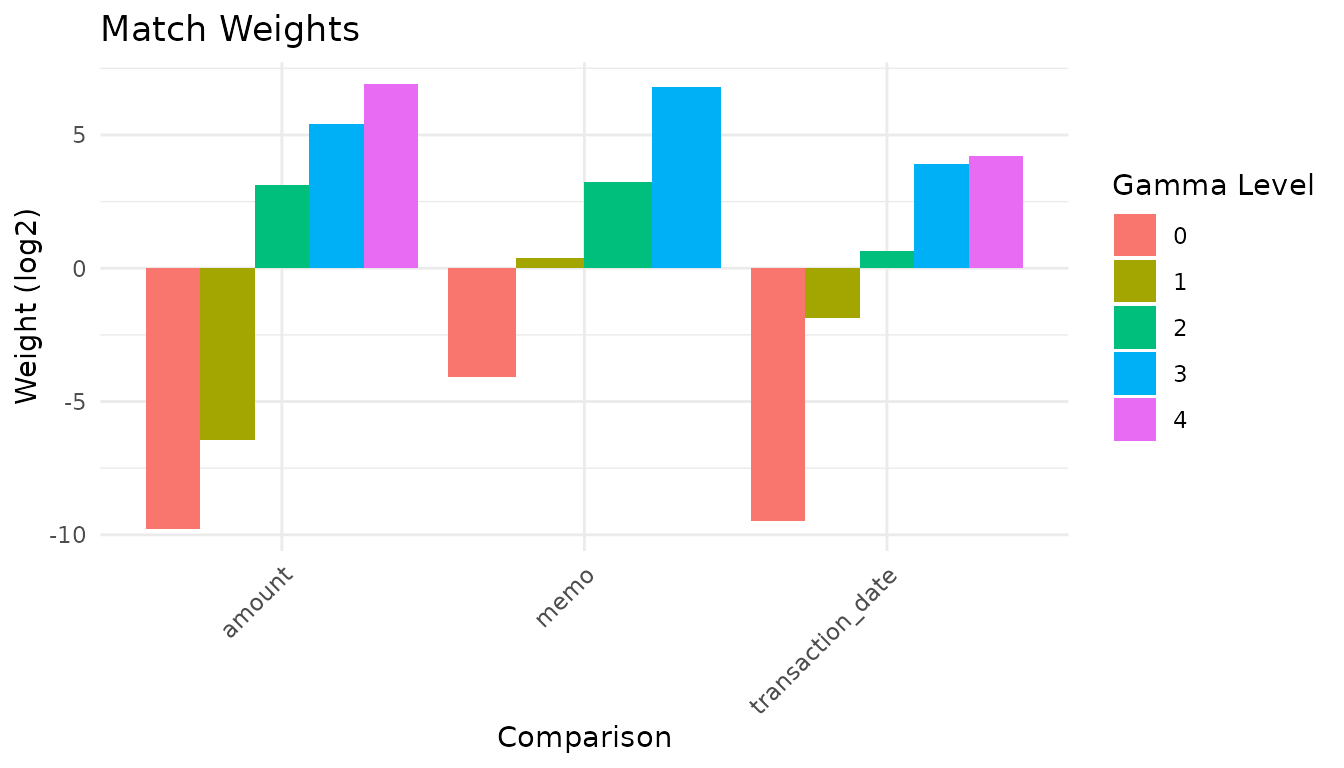
autoplot(model, type = 'parameters')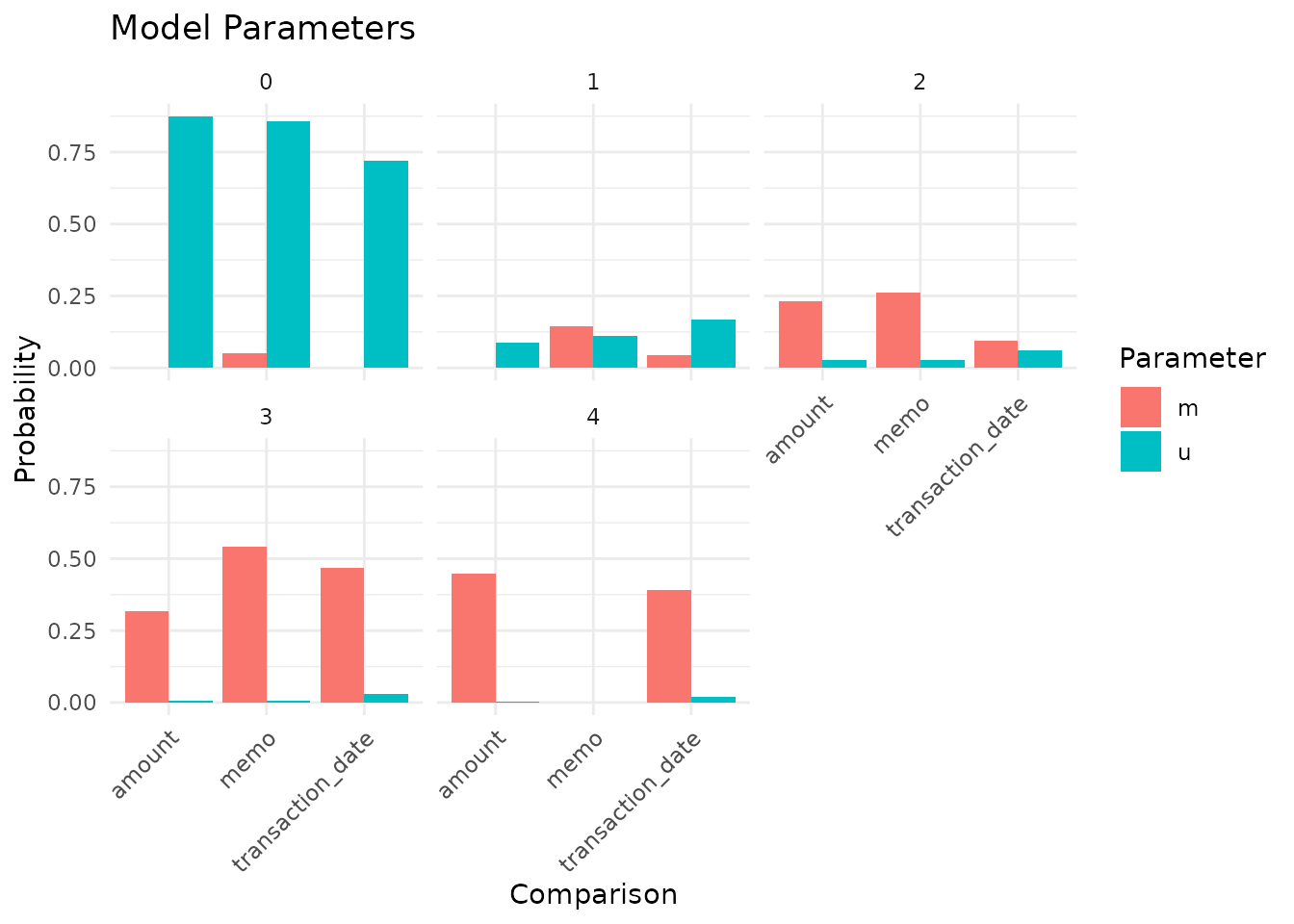
Predict
predictions <- predict(model, threshold = 0.001)
predictions
#> # A tibble: 612,563 × 8
#>    unique_id_l unique_id_r gamma_amount gamma_memo gamma_transaction_date
#>  *       <dbl>       <dbl>        <int>      <int>                  <int>
#>  1       14152       14152            4          1                      1
#>  2       15226       15226            3          1                      3
#>  3       15516       15516            3          1                      1
#>  4       42776       42776            2          2                      1
#>  5           1          15            2          3                      0
#>  6           5           8            0          3                      4
#>  7          55       37632            0          3                      2
#>  8          72       37628            0          3                      1
#>  9         117       26283            0          3                      1
#> 10         150         162            0          3                      1
#> # ℹ 612,553 more rows
#> # ℹ 3 more variables: match_weight <dbl>, total_match_weight <dbl>,
#> #   match_probability <dbl>
autoplot(predictions)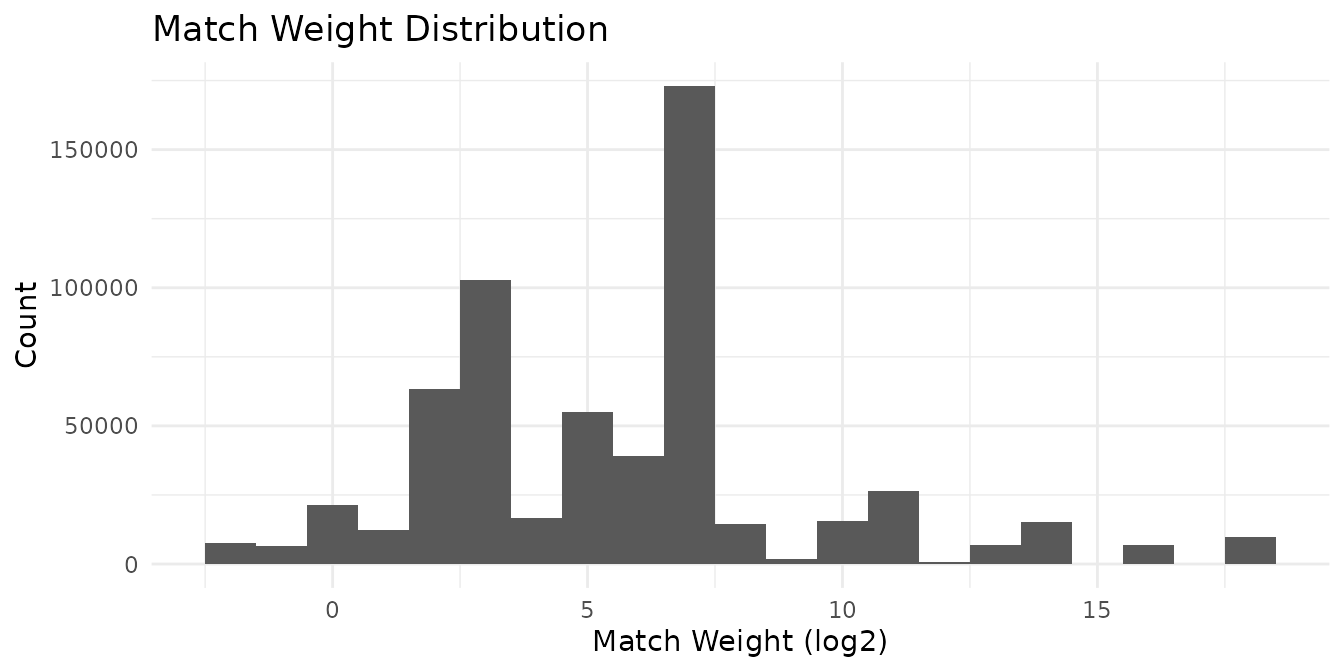
autoplot(predictions, which = 1)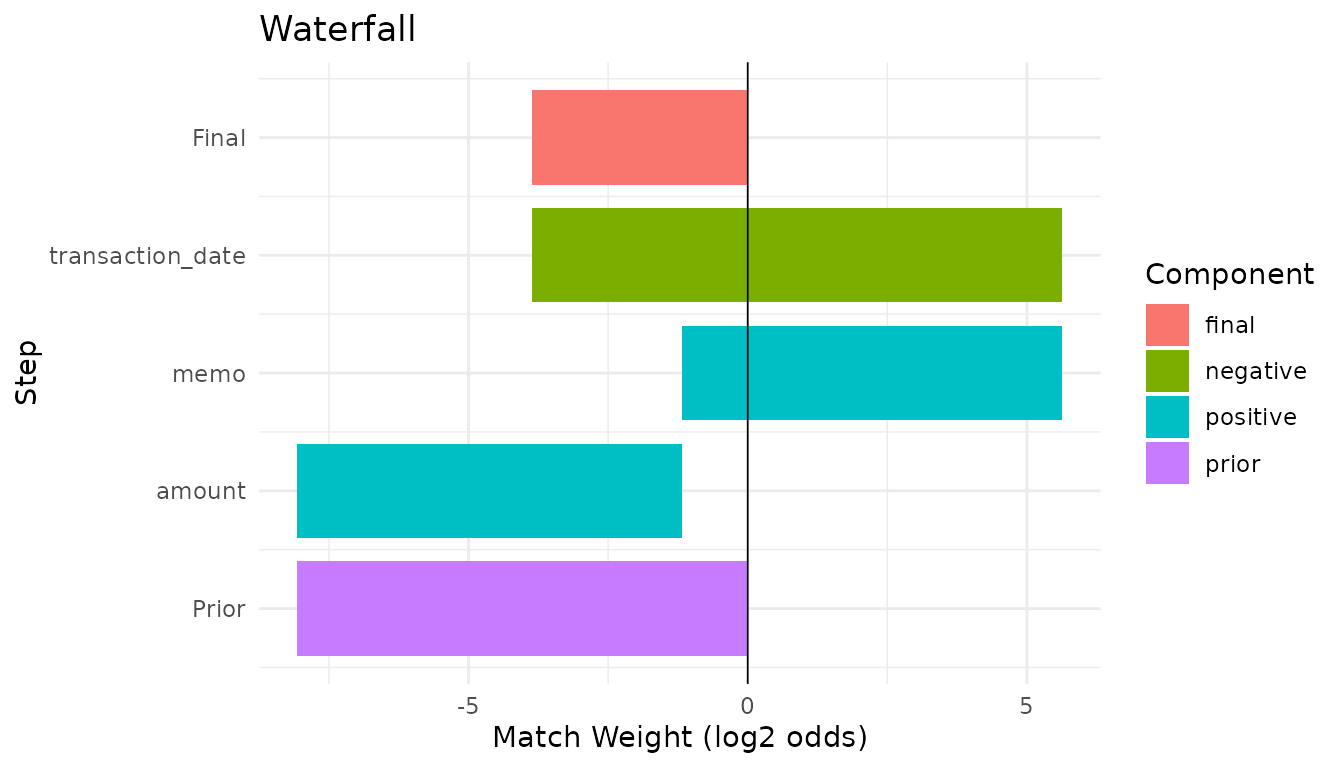
Evaluate against ground truth
acc <- il_accuracy(model, labels_col = 'ground_truth')
acc
#> # A tibble: 102 × 16
#>     threshold    tp     fp    fn     tn fn_blocking_miss precision recall     f1
#>         <dbl> <int>  <int> <int>  <int>            <int>     <dbl>  <dbl>  <dbl>
#>  1    0       45326 1.28e6     0      0                0    0.0343      1 0.0663
#>  2    1.22e-9 45326 1.28e6     0      0                0    0.0343      1 0.0663
#>  3    3.71e-9 45326 1.25e6     0  27038                0    0.0350      1 0.0677
#>  4    2.81e-8 45326 1.21e6     0  68900                0    0.0362      1 0.0698
#>  5    8.55e-8 45326 1.19e6     0  83586                0    0.0366      1 0.0706
#>  6    2.18e-7 45326 1.15e6     0 128271                0    0.0380      1 0.0732
#>  7    2.90e-7 45326 1.04e6     0 240600                0    0.0419      1 0.0805
#>  8    6.62e-7 45326 1.03e6     0 246447                0    0.0422      1 0.0809
#>  9    8.83e-7 45326 1.01e6     0 266780                0    0.0430      1 0.0824
#> 10    1.52e-6 45326 9.74e5     0 302556                0    0.0445      1 0.0852
#> # ℹ 92 more rows
#> # ℹ 7 more variables: f2 <dbl>, f0_5 <dbl>, specificity <dbl>, npv <dbl>,
#> #   accuracy <dbl>, p4 <dbl>, phi <dbl>
autoplot(acc)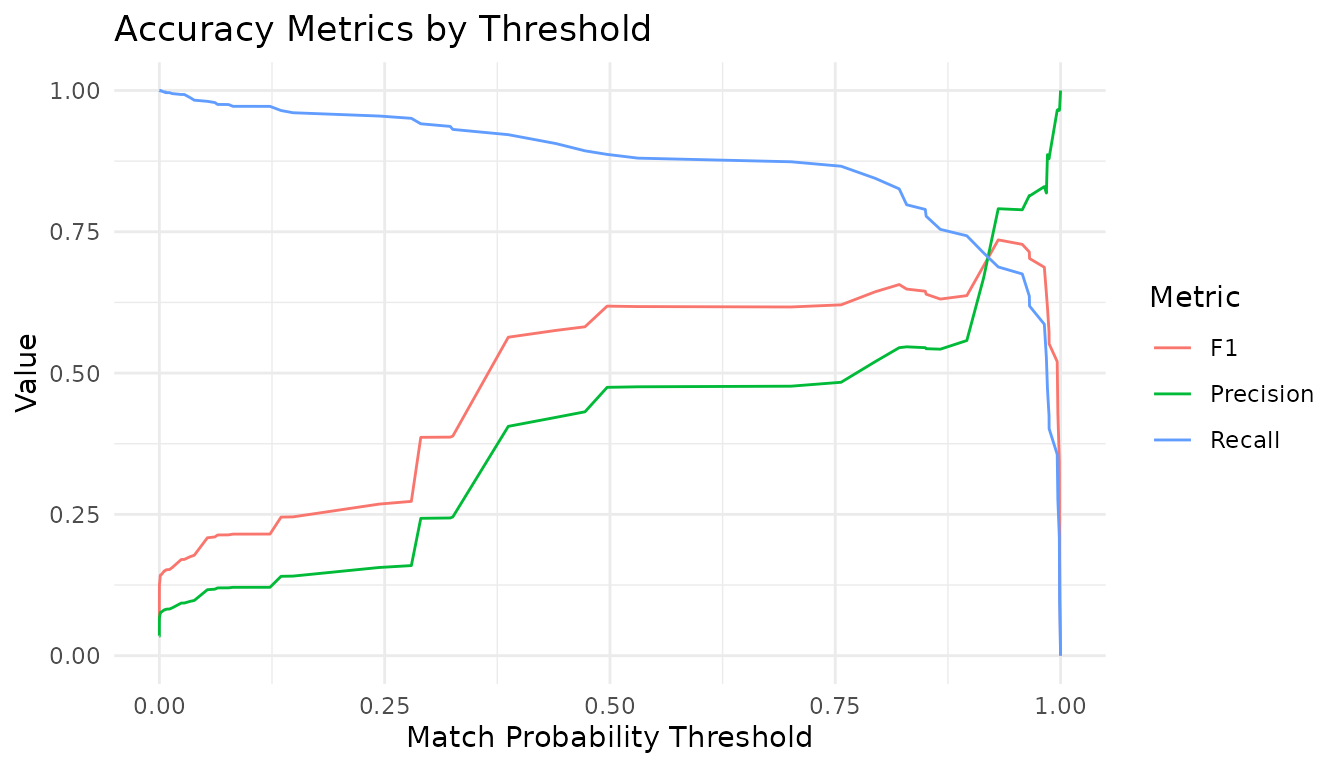
Error inspection
errors <- il_errors(model, labels_col = 'ground_truth', threshold = 0.5)
errors[errors$error_type == 'false_positive', ]
#> # A tibble: 53,342 × 6
#>    unique_id_l unique_id_r match_weight match_probability true_label error_type
#>          <dbl>       <dbl>        <dbl>             <dbl> <lgl>      <chr>
#>  1       11598       41635        13.4              0.975 FALSE      false_posi…
#>  2       17692       40426        13.1              0.968 FALSE      false_posi…
#>  3       18760       44191        11.9              0.933 FALSE      false_posi…
#>  4       21055       33130        11.9              0.933 FALSE      false_posi…
#>  5       22883       30747         8.91             0.632 FALSE      false_posi…
#>  6       26067       31021        13.1              0.968 FALSE      false_posi…
#>  7       24741        1996        10.1              0.797 FALSE      false_posi…
#>  8       17458       41657        11.9              0.933 FALSE      false_posi…
#>  9       17099       21321        10.1              0.797 FALSE      false_posi…
#> 10       17813       23332        11.9              0.933 FALSE      false_posi…
#> # ℹ 53,332 more rows
errors[errors$error_type == 'false_negative', ]
#> # A tibble: 4,839 × 6
#>    unique_id_l unique_id_r match_weight match_probability true_label error_type
#>          <dbl>       <dbl>        <dbl>             <dbl> <lgl>      <chr>
#>  1         328         328         7.05            0.321  TRUE       false_nega…
#>  2         374         374         7.48            0.389  TRUE       false_nega…
#>  3        3626        3626         7.75            0.435  TRUE       false_nega…
#>  4        4876        4876         5.93            0.178  TRUE       false_nega…
#>  5        4899        4899         3.23            0.0323 TRUE       false_nega…
#>  6        8645        8645         7.40            0.376  TRUE       false_nega…
#>  7       16285       16285         7.44            0.382  TRUE       false_nega…
#>  8       20064       20064         8.10            0.495  TRUE       false_nega…
#>  9       19958       19958         3.58            0.0409 TRUE       false_nega…
#> 10       21847       21847         7.05            0.321  TRUE       false_nega…
#> # ℹ 4,829 more rows
Cleanup
il_cleanup(model)
DBI::dbDisconnect(con, shutdown = TRUE)
il_cleanup(model) only removes tables owned by that
model. If an interactive run fails before you keep the model object,
call il_cleanup_all(con) to remove all irelink
tables from the connection before disconnecting.