
This vignette shows how to link records across two datasets using the
FEBRL (Freely Extensible Biomedical Record Linkage) benchmark data.
Dataset 4a contains 5,000 original records, and dataset 4b contains
5,000 duplicates, one for each original. The duplicate records include
typographical errors, missing values, and transpositions. Ground truth
is stored in the rec_id column, so records that share the
same base number, such as rec-1070-org and
rec-1070-dup-0, refer to the same entity.
Load the data
head(febrl4a)
#> # A tibble: 6 × 11
#>   rec_id    given_name surname street_number address_1 address_2 suburb postcode
#>   <chr>     <chr>      <chr>           <int> <chr>     <chr>     <chr>     <int>
#> 1 rec-1070… michaela   neumann             8 stanley … miami     winst…     4223
#> 2 rec-1016… courtney   painter            12 pinkerto… bega fla… richl…     4560
#> 3 rec-4405… charles    green              38 salkausk… kela      dapto      4566
#> 4 rec-1288… vanessa    parr              905 macquoid… broadbri… south…     2135
#> 5 rec-3585… mikayla    mallon…            37 randwick… avalind   hoppe…     4552
#> 6 rec-298-… blake      howie               1 cutlack … belmont … budge…     6017
#> # ℹ 3 more variables: state <chr>, date_of_birth <int>, soc_sec_id <int>
head(febrl4b)
#> # A tibble: 6 × 11
#>   rec_id    given_name surname street_number address_1 address_2 suburb postcode
#>   <chr>     <chr>      <chr>           <int> <chr>     <chr>     <chr>     <int>
#> 1 rec-561-… elton      NA                  3 light se… pinehill  winde…     3212
#> 2 rec-2642… mitchell   maxon              47 edkins s… lochaoair north…     3355
#> 3 rec-608-… NA         white              72 lambrigg… kelgoola  broad…     3159
#> 4 rec-3239… elk i      menzies             1 lyster p… NA        north…     2585
#> 5 rec-2886… NA         garang…            NA may maxw… springet… fores…     2342
#> 6 rec-4285… sophie     manson             14 elizabet… manorhou… gorok…     3465
#> # ℹ 3 more variables: state <chr>, date_of_birth <int>, soc_sec_id <int>
Explore data quality
Check completeness across both tables. Table B has more missing values because of the corruption process:
con <- DBI::dbConnect(duckdb::duckdb())
comp <- il_completeness(febrl4a, febrl4b, con = con)
comp
#> # A tibble: 22 × 5
#>    table   column        n_total n_non_null pct_non_null
#>    <chr>   <chr>           <int>      <int>        <dbl>
#>  1 table_1 rec_id           5000       5000        100
#>  2 table_1 given_name       5000       4888         97.8
#>  3 table_1 surname          5000       4952         99.0
#>  4 table_1 street_number    5000       4842         96.8
#>  5 table_1 address_1        5000       4902         98.0
#>  6 table_1 address_2        5000       4580         91.6
#>  7 table_1 suburb           5000       4945         98.9
#>  8 table_1 postcode         5000       5000        100
#>  9 table_1 state            5000       4950         99
#> 10 table_1 date_of_birth    5000       4906         98.1
#> # ℹ 12 more rows
autoplot(comp)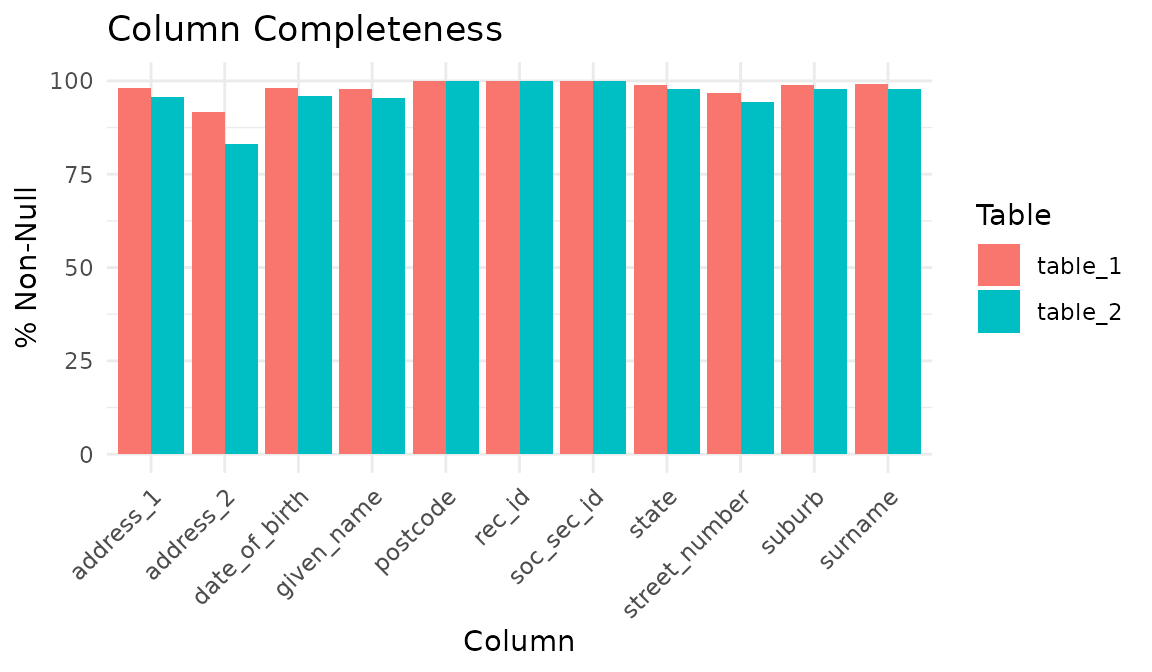
Define the specification
For linkage across two tables, set link_type = "link"
when you create the model. This spec uses name similarity, date-of-birth
matching, and exact postcode matching:
spec <- il_spec() |>
  il_compare(given_name, cl_name()) |>
  il_compare(surname, cl_name()) |>
  il_compare(date_of_birth, cl_exact()) |>
  il_compare(postcode, cl_exact()) |>
  il_block_on(surname) |>
  il_block_on(given_name)

spec
#> Linkage Specification
#>   Comparisons (4):
#>     given_name : levels
#>     surname : levels
#>     date_of_birth : exact
#>     postcode : exact
#>   Blocking rules (2, OR-ed):
#>     1. surname
#>     2. given_name
Train the model
Create a link-type model with both tables:
model <- il_model(
  febrl4a, febrl4b,
  spec = spec,
  con = con,
  link_type = 'link'
)

model
#> irelink Model
#>   Status: Untrained
#>   Link type: link
#>   Records: 5000
#>   Records (right): 5000
#>   Comparisons: 4
#>   Blocking rules: 2
Next, estimate the prior match probability and the u-probabilities, then run EM:
model <- il_estimate_prior(
  model,
  block_on(given_name, surname),
  block_on(surname, suburb),
  recall = 0.6
)

model <- il_estimate_u(model, max_pairs = 1e5)
model <- il_estimate_em(model, block_on(surname))
#> EM trained: given_name, date_of_birth, and postcode | skipped (blocked on):
#> surname
model <- il_estimate_em(model, block_on(suburb))
#> EM trained: given_name, surname, date_of_birth,
#> and postcode
Inspect the model
autoplot(model)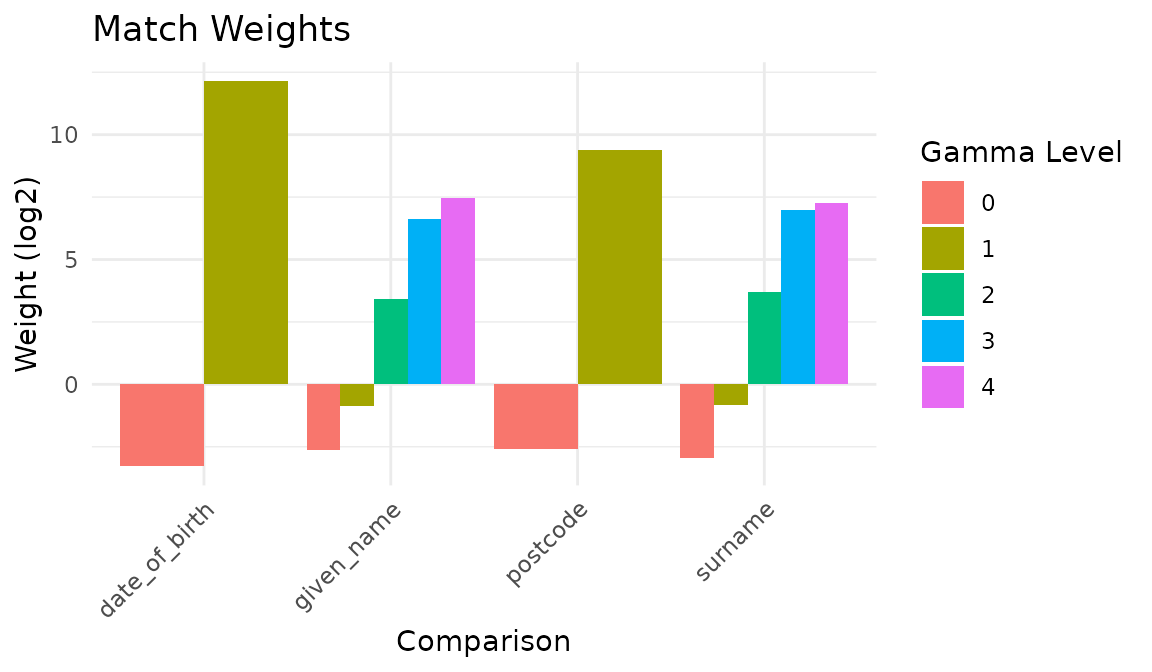
autoplot(model, type = 'parameters')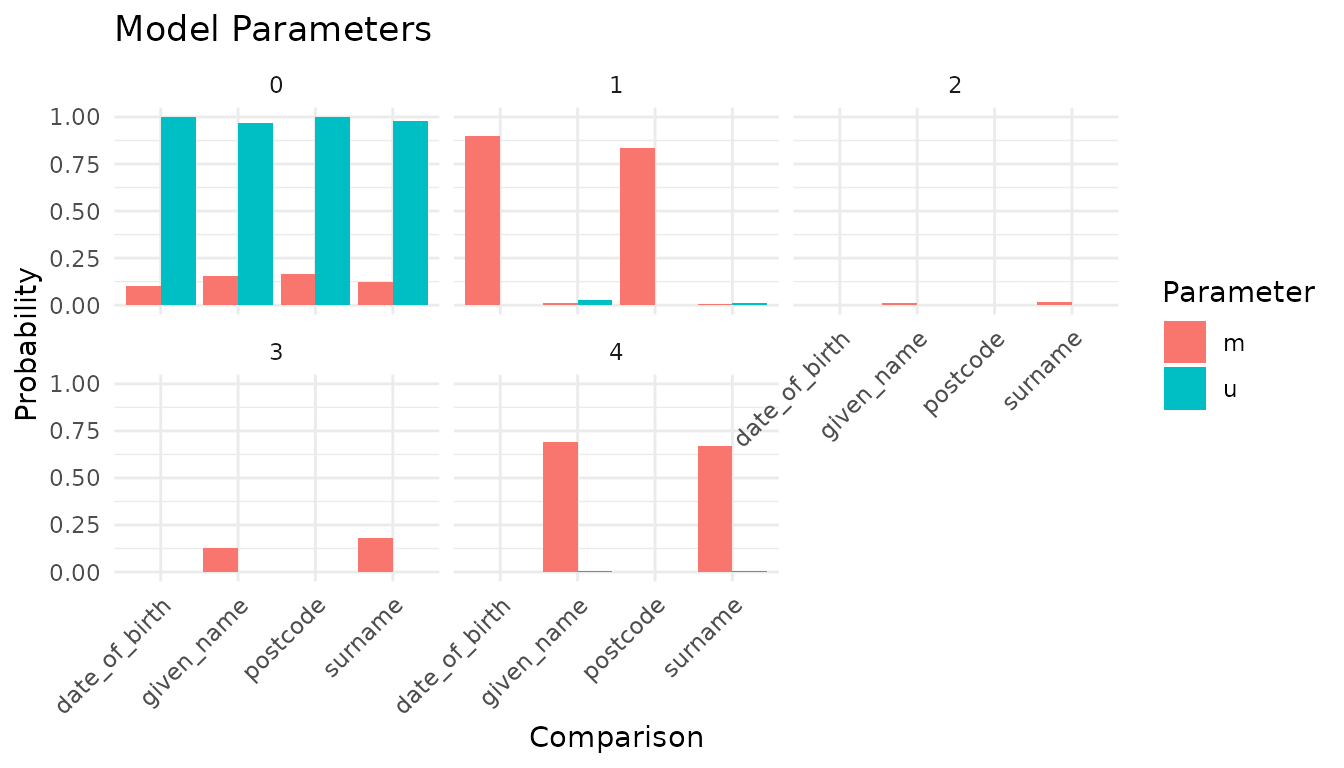
il_weights(model)
#> # A tibble: 14 × 5
#>    comparison    gamma_level  m_prob   u_prob weight
#>    <chr>               <int>   <dbl>    <dbl>  <dbl>
#>  1 given_name              0 0.158   0.970    -2.62
#>  2 given_name              1 0.0136  0.0245   -0.853
#>  3 given_name              2 0.0137  0.000891  3.94
#>  4 given_name              3 0.126   0.00131   6.60
#>  5 given_name              4 0.688   0.00327   7.72
#>  6 surname                 0 0.127   0.980    -2.95
#>  7 surname                 1 0.00698 0.0144   -1.05
#>  8 surname                 2 0.0165  0.000448  5.20
#>  9 surname                 3 0.182   0.000758  7.90
#> 10 surname                 4 0.668   0.00396   7.40
#> 11 date_of_birth           0 0.104   1.000    -3.26
#> 12 date_of_birth           1 0.896   0.000127 12.8
#> 13 postcode                0 0.167   0.999    -2.58
#> 14 postcode                1 0.833   0.00107   9.60
Predict and cluster
autoplot(predictions)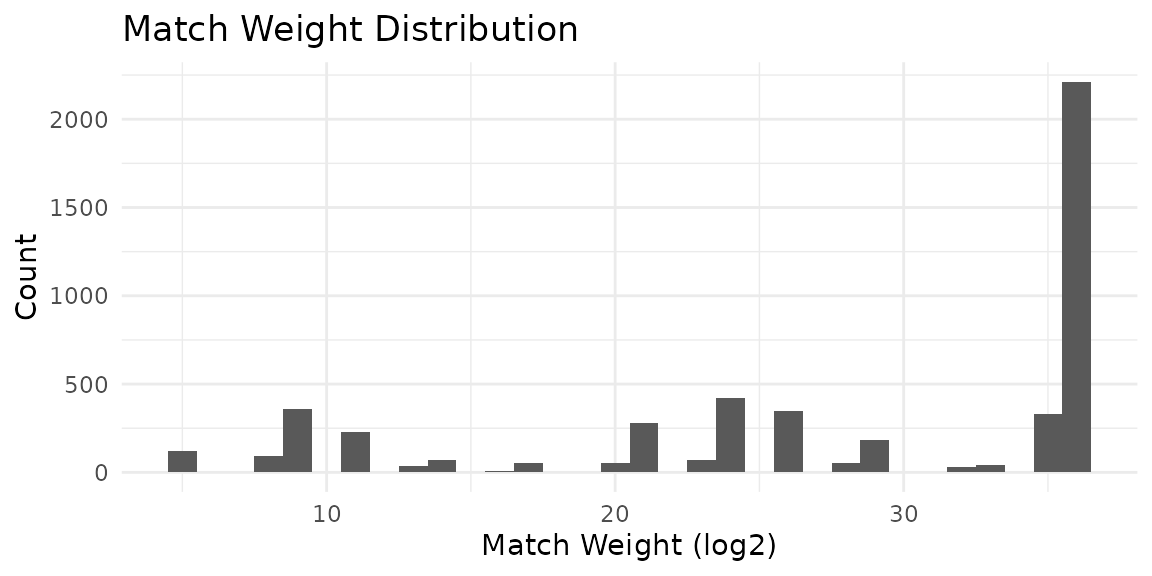
Cluster the pairs to resolve entities:
clusters <- il_cluster(predictions, threshold = 0.85)
head(clusters)
#> # A tibble: 6 × 2
#>   unique_id cluster_id
#>   <chr>     <chr>
#> 1 4855      cluster_2517
#> 2 790       cluster_184
#> 3 2824      cluster_1384
#> 4 2453      cluster_2271
#> 5 4311      cluster_323
#> 6 4936      cluster_194
Evaluate against ground truth
The rec_id column stores the ground truth. Extract
entity IDs and build pairwise labels:
# Extract entity number from rec_id (e.g., "rec-1070-org" -> "1070")
entity_a <- sub('^rec-(\\d+)-org$', '\\1', febrl4a$rec_id)
entity_b <- sub('^rec-(\\d+)-dup-\\d+$', '\\1', febrl4b$rec_id)

# Build id-entity lookup (unique_id auto-generated by il_model)
ids_a <- data.frame(unique_id = seq_len(nrow(febrl4a)), entity = entity_a)
ids_b <- data.frame(unique_id = seq_len(nrow(febrl4b)), entity = entity_b)

# True matches: same entity across tables
positives <- merge(ids_a, ids_b, by = 'entity')
names(positives) <- c('entity', 'unique_id_l', 'unique_id_r')
positives$is_match <- 1L
positives <- positives[, c('unique_id_l', 'unique_id_r', 'is_match')]

# Sample non-matching pairs
set.seed(42)
n_neg <- min(nrow(positives), 2000L)
neg_l <- sample(ids_a$unique_id, n_neg, replace = TRUE)
neg_r <- sample(ids_b$unique_id, n_neg, replace = TRUE)
ent_l <- ids_a$entity[match(neg_l, ids_a$unique_id)]
ent_r <- ids_b$entity[match(neg_r, ids_b$unique_id)]
negatives <- data.frame(
  unique_id_l = neg_l,
  unique_id_r = neg_r,
  is_match = ifelse(ent_l == ent_r, 1L, 0L)
)

labels <- rbind(positives, negatives)
nrow(labels)
#> [1] 7000
sum(labels$is_match)
#> [1] 5001
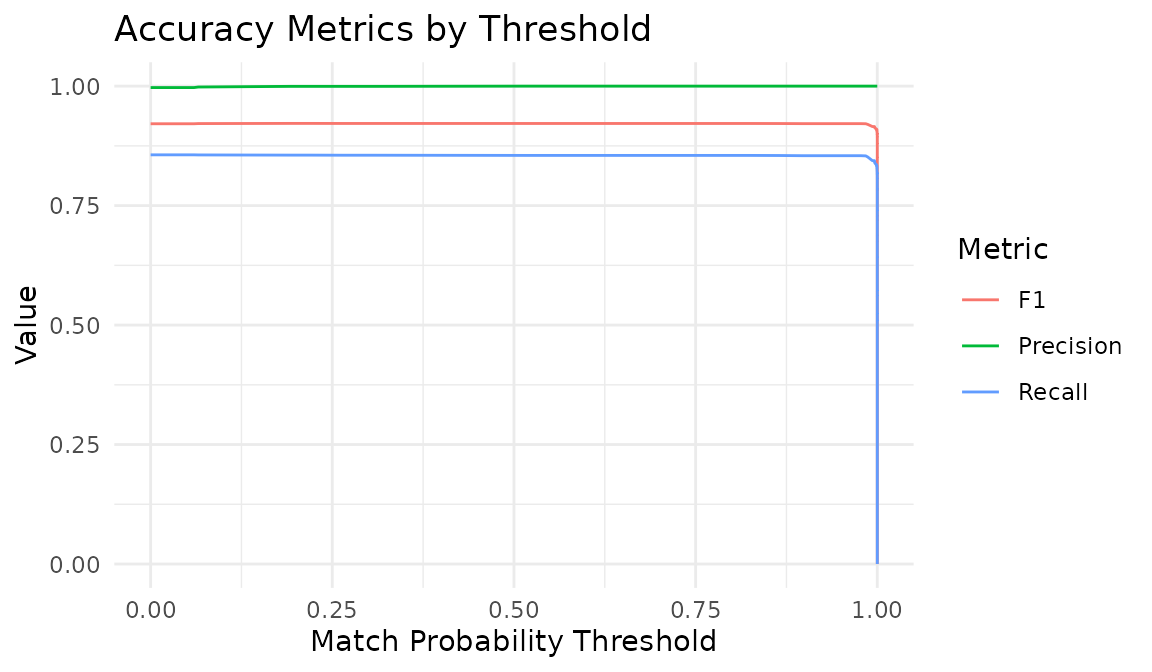
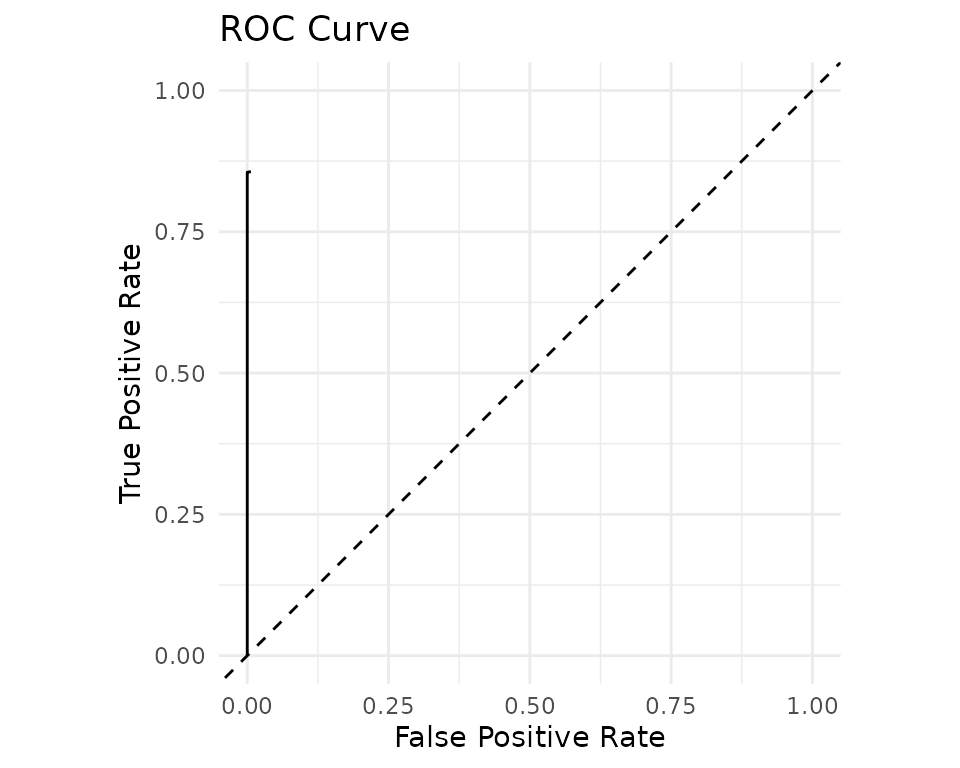
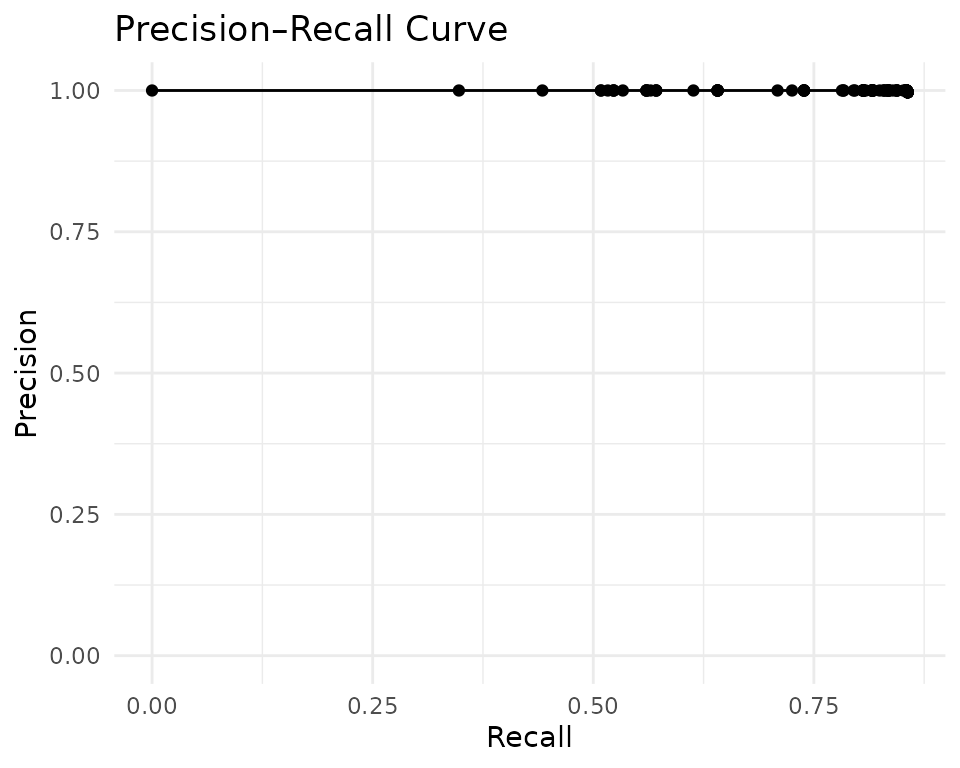
labels includes all true cross-table matches, so any
true match missed by the blocking rules is counted as a false negative
in the evaluation curves below.
Cleanup
il_cleanup(model)
DBI::dbDisconnect(con, shutdown = TRUE)
il_cleanup(model) only removes tables owned by that
model. If an interactive run fails before you keep the model object,
call il_cleanup_all(con) to remove all irelink
tables from the connection before disconnecting.