
Deduplicating 50k Synthetic Records
Source:vignettes/articles/deduplicate-50k.Rmd
deduplicate-50k.RmdThis vignette reproduces the Splink
“Deduplicate 50k synthetic” demo in irelink. The data
is based on historical people scraped from Wikidata and includes
duplicate records with realistic errors such as typos, missing values,
and swapped fields. The cluster column provides the
ground-truth entity labels used in evaluation.
This vignette requires nanoparquet to read the remote Parquet file and only compiles when the package and the data URL are both available.
Load the data
library(irelink)
#>
#> Attaching package: 'irelink'
#> The following object is masked from 'package:base':
#>
#>     months
library(ggplot2)

df
#> # A data frame: 50,578 × 11
#>    unique_id   cluster  full_name     first_and_surname first_name surname dob
#>    <chr>       <chr>    <chr>         <chr>             <chr>      <chr>   <chr>
#>  1 Q2296770-1  Q2296770 thomas cliff… thomas chudleigh  thomas     chudle… 1630…
#>  2 Q2296770-2  Q2296770 thomas of ch… thomas chudleigh  thomas     chudle… 1630…
#>  3 Q2296770-3  Q2296770 tom 1st baro… tom chudleigh     tom        chudle… 1630…
#>  4 Q2296770-4  Q2296770 thomas 1st c… thomas chudleigh  thomas     chudle… 1630…
#>  5 Q2296770-5  Q2296770 thomas cliff… thomas chudleigh  thomas     chudle… 1630…
#>  6 Q2296770-6  Q2296770 thomas cliff… thomas chudleigh  thomas     chudle… 1630…
#>  7 Q2296770-7  Q2296770 tom baron ch… tom chudleigh     tom        chudle… 1630…
#>  8 Q2296770-8  Q2296770 tom clifford… tom chudleigh     tom        chudle… NA
#>  9 Q2296770-9  Q2296770 thomas cliff… thomas chudleigh  thomas     chudle… 1630…
#> 10 Q2296770-10 Q2296770 thomas cliff… thomas chudleigh  thomas     chudle… NA
#> # ℹ 50,568 more rows
#> # ℹ 4 more variables: birth_place <chr>, postcode_fake <chr>, gender <chr>,
#> #   occupation <chr>
Profile the data
Use completeness and value distributions to choose blocking rules and comparisons:
df |>
  il_completeness(con = con) |>
  autoplot()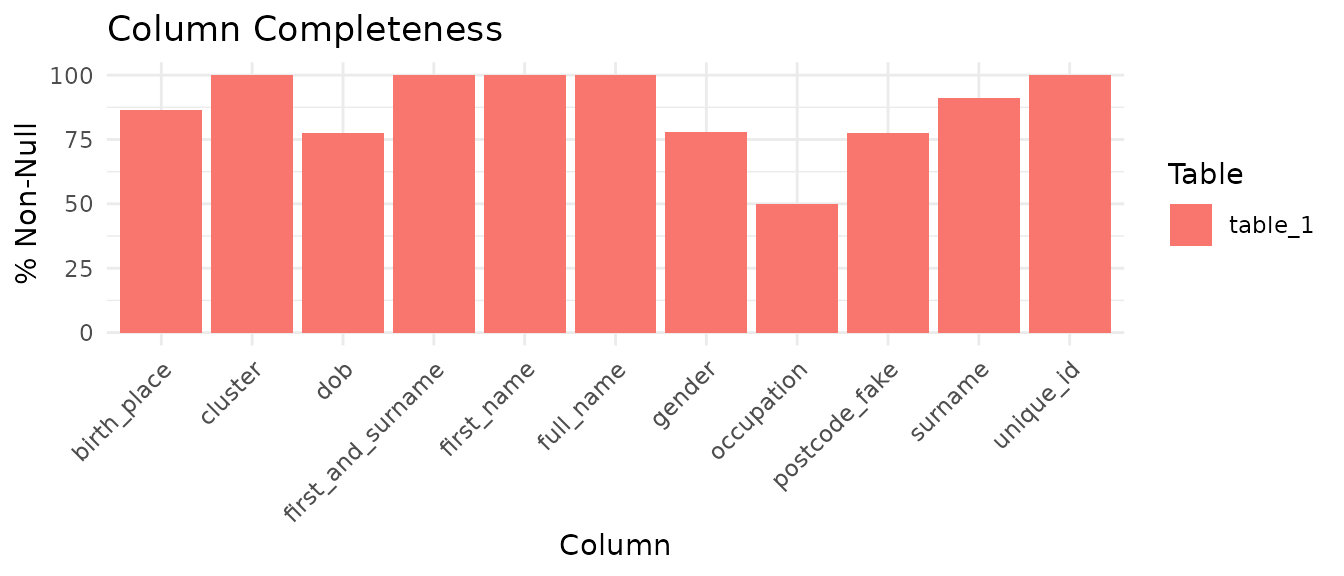
il_profile(df, first_name, surname, dob, birth_place, con = con, top_n = 8)
#> # A tibble: 32 × 3
#>    column     value       n
#>    <chr>      <chr>   <dbl>
#>  1 first_name william  2780
#>  2 first_name john     2736
#>  3 first_name thomas   1448
#>  4 first_name george   1415
#>  5 first_name henry    1306
#>  6 first_name james    1265
#>  7 first_name sir      1262
#>  8 first_name charles  1216
#>  9 surname    NA       4515
#> 10 surname    baronet   615
#> # ℹ 22 more rows
Choose blocking rules
il_suggest_blocking(df, con = con)
#> # A tibble: 10 × 6
#>    rule              n_distinct coverage   n_pairs pct_of_cartesian score
#>    <chr>                  <int>    <dbl>     <int>            <dbl> <dbl>
#>  1 cluster                 5156    1        303961           0.0238 1.000
#>  2 full_name              25573    0.999     87973           0.0069 0.999
#>  3 first_and_surname      20479    0.999    262393           0.0205 0.998
#>  4 first_name              4413    0.999  16372982           1.28   0.986
#>  5 surname                 6195    0.911    733085           0.0573 0.910
#>  6 birth_place             2373    0.863   4923790           0.385  0.860
#>  7 postcode_fake          12363    0.774    112172           0.0088 0.774
#>  8 dob                     8985    0.774   1549081           0.121  0.774
#>  9 occupation               453    0.5    12573944           0.983  0.495
#> 10 gender                     7    0.778 561648436          43.9    0.436
The cumulative_pairs column shows the total number of
unique pairs produced so far:
il_count_pairs(
  df,
  block_on(surname, dob),
  block_on(first_name, dob),
  block_on(first_name, surname),
  block_on(dob, birth_place),
  con = con
)
#> # A tibble: 4 × 4
#>   rule                 n_pairs cumulative_pairs pct_of_cartesian
#>   <chr>                  <dbl>            <dbl>            <dbl>
#> 1 surname & dob          62893            62893           0.0049
#> 2 first_name & dob       67757            92798           0.0073
#> 3 first_name & surname  243656           298602           0.0233
#> 4 dob & birth_place      66657           314273           0.0246
Define the specification
Apply term-frequency adjustment to birth_place and
occupation so common values such as “London” receive less
weight than rare ones:
spec <- il_spec() |>
  il_compare(first_name, cl_name()) |>
  il_compare(surname, cl_name()) |>
  il_compare(dob, cl_dob()) |>
  il_compare(postcode_fake, cl_postcode()) |>
  il_compare(birth_place, cl_exact(term_frequency = TRUE)) |>
  il_compare(occupation, cl_exact(term_frequency = TRUE)) |>
  il_block_on(first_name ~ il_substr(1, 3), surname ~ il_substr(1, 4)) |>
  il_block_on(surname, dob) |>
  il_block_on(first_name, dob) |>
  il_block_on(postcode_fake, first_name) |>
  il_block_on(postcode_fake, surname) |>
  il_block_on(dob, birth_place) |>
  il_block_on(postcode_fake ~ il_substr(1, 3), dob) |>
  il_block_on(postcode_fake ~ il_substr(1, 3), first_name) |>
  il_block_on(postcode_fake ~ il_substr(1, 3), surname) |>
  il_block_on(
    first_name ~ il_substr(1, 2),
    surname ~ il_substr(1, 2),
    dob ~ il_substr(1, 4)
  )

spec
#> Linkage Specification
#>   Comparisons (6):
#>     first_name : levels
#>     surname : levels
#>     dob : levels
#>     postcode_fake : levels
#>     birth_place : exact
#>     occupation : exact
#>   Blocking rules (10, OR-ed):
#>     1. first_name [il_substr(1,3)], surname [il_substr(1,4)]
#>     2. surname, dob
#>     3. first_name, dob
#>     4. postcode_fake, first_name
#>     5. postcode_fake, surname
#>     6. dob, birth_place
#>     7. postcode_fake [il_substr(1,3)], dob
#>     8. postcode_fake [il_substr(1,3)], first_name
#>     9. postcode_fake [il_substr(1,3)], surname
#>     10. first_name [il_substr(1,2)], surname [il_substr(1,2)], dob [il_substr(1,4)]
Train the model
model <- df |>
  il_model(spec = spec, con = con) |>
  il_estimate_prior(
    block_on(first_name, surname, dob),
    block_on(dob, postcode_fake),
    recall = 0.6
  ) |>
  il_estimate_u(max_pairs = 5e6) |>
  il_estimate_em(block_on(first_name, surname)) |>
  il_estimate_em(block_on(dob))
#> EM trained: dob, postcode_fake, birth_place, and occupation | skipped (blocked
#> on): first_name and surname
#> EM trained: first_name, surname, postcode_fake, birth_place, and occupation |
#> skipped (blocked on): dob
Inspect the trained model
summary(model)
#> irelink Model
#>   Status: Trained
#>   Link type: dedupe
#>   Records: 50578
#>   Comparisons: 6
#>   Blocking rules: 10
#>
#>   Parameters:
#>     prior: 0.0002209564
#>     comparisons: # A tibble: 25 × 4
#>      comparisons:    comparison gamma_level      m        u
#>      comparisons:    <chr>            <int>  <dbl>    <dbl>
#>      comparisons:  1 first_name           0 0.188  0.962
#>      comparisons:  2 first_name           1 0.122  0.0192
#>      comparisons:  3 first_name           2 0.0756 0.00389
#>      comparisons:  4 first_name           3 0.0616 0.00157
#>      comparisons:  5 first_name           4 0.553  0.0129
#>      comparisons:  6 surname              0 0.0649 0.981
#>      comparisons:  7 surname              1 0.0229 0.0176
#>      comparisons:  8 surname              2 0.0392 0.000485
#>      comparisons:  9 surname              3 0.0937 0.000352
#>      comparisons: 10 surname              4 0.779  0.000678
#>      comparisons: # ℹ 15 more rows
#>     u_estimation: 5000703
#>      u_estimation: FALSE
#>      u_estimation: NULL
#>      u_estimation: NULL
#>      u_estimation: 5000000
#>      u_estimation: 1
autoplot(model)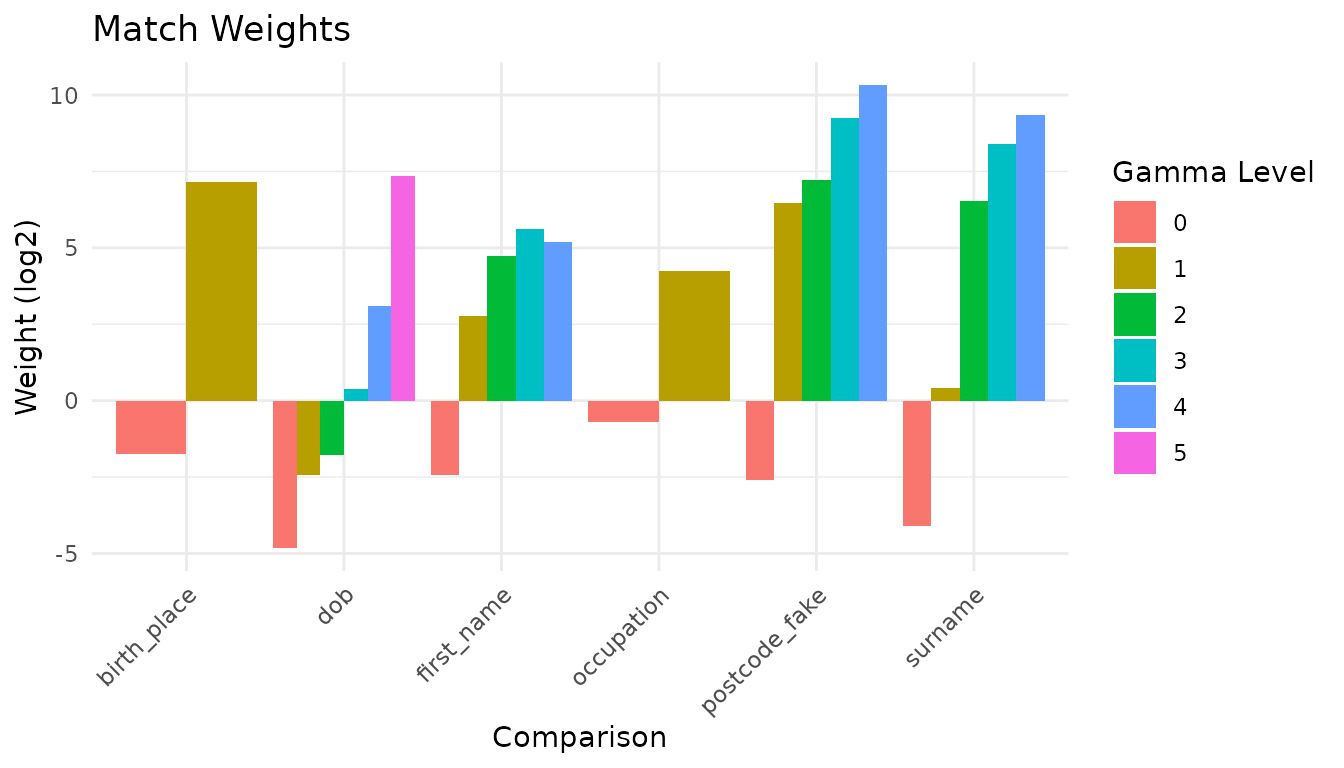
autoplot(model, type = 'parameters')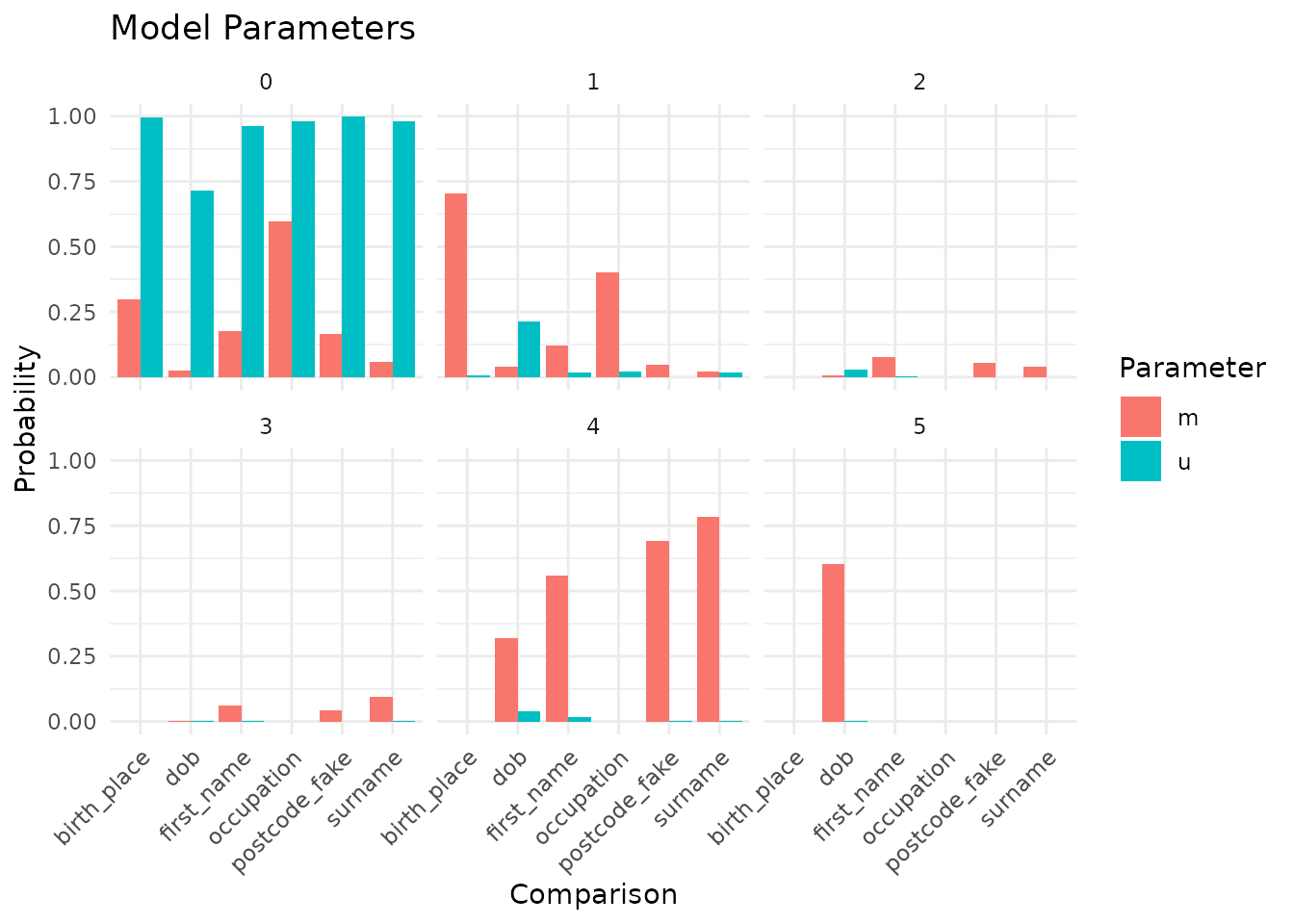
autoplot(il_unlinkables(model))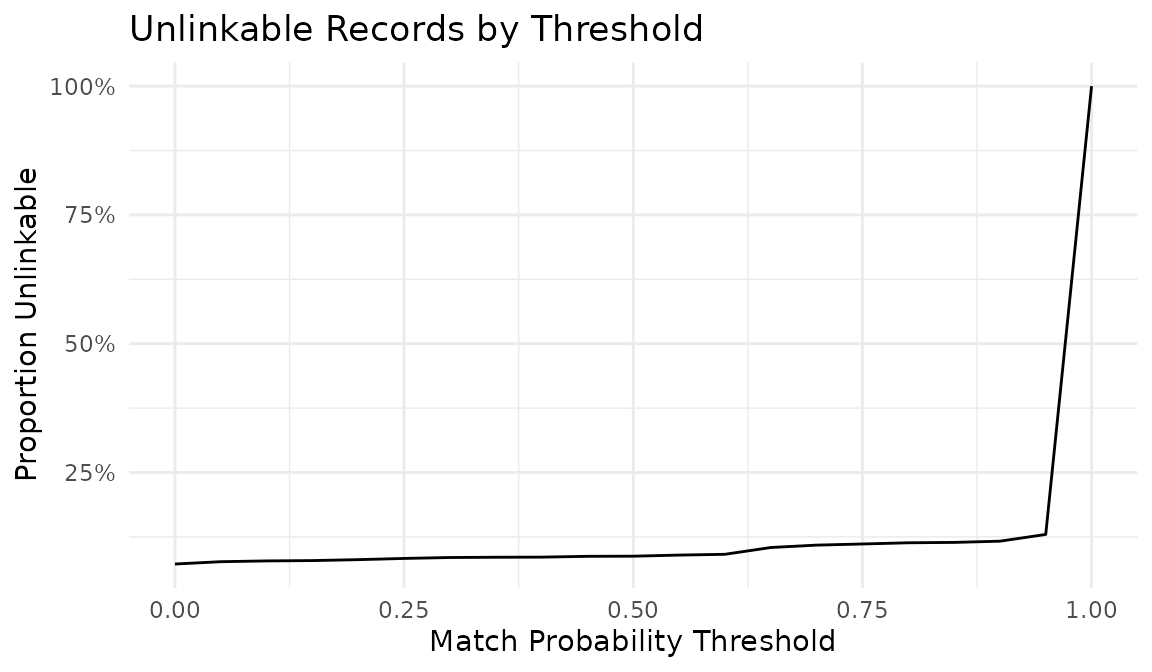
Predict
predictions <- predict(model, threshold = 0.5)
predictions
#> # A tibble: 237,463 × 13
#>    unique_id_l unique_id_r gamma_first_name gamma_surname gamma_dob
#>  * <chr>       <chr>                  <int>         <int>     <int>
#>  1 Q7525972-2  Q7526839-14                4             4         1
#>  2 Q7526084-2  Q7527398-16                4             4        -1
#>  3 Q7526084-4  Q7527398-11                4             4         1
#>  4 Q7526084-7  Q7527398-11                4             4        -1
#>  5 Q7526084-12 Q7527398-11                4             4        -1
#>  6 Q7525972-1  Q7527398-7                 4             4         2
#>  7 Q7525972-2  Q7527398-2                 4             4         2
#>  8 Q7526084-7  Q7528085-12                4             4        -1
#>  9 Q7526300-5  Q7528085-6                 4             4        -1
#> 10 Q7525972-2  Q7528085-6                 4             4         1
#> # ℹ 237,453 more rows
#> # ℹ 8 more variables: gamma_postcode_fake <int>, gamma_birth_place <int>,
#> #   gamma_occupation <int>, match_weight <dbl>, tf_adj_birth_place <dbl>,
#> #   tf_adj_occupation <dbl>, total_match_weight <dbl>, match_probability <dbl>
autoplot(predictions)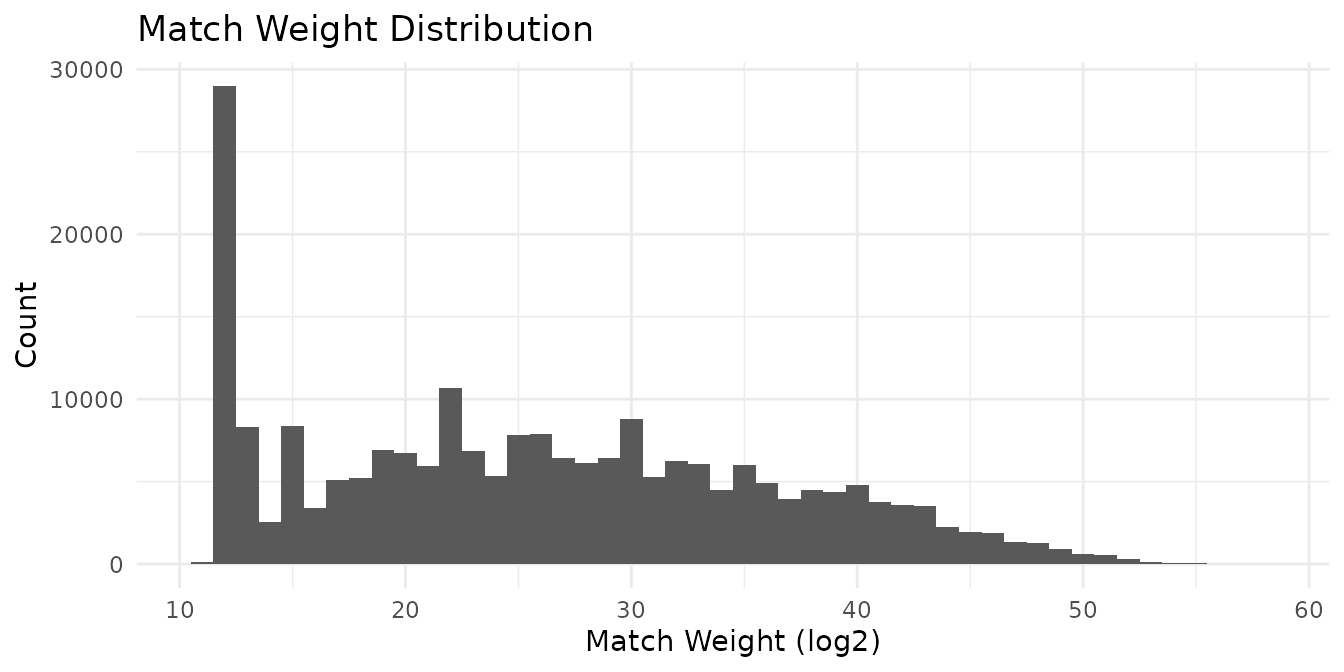
autoplot(predictions, which = 1)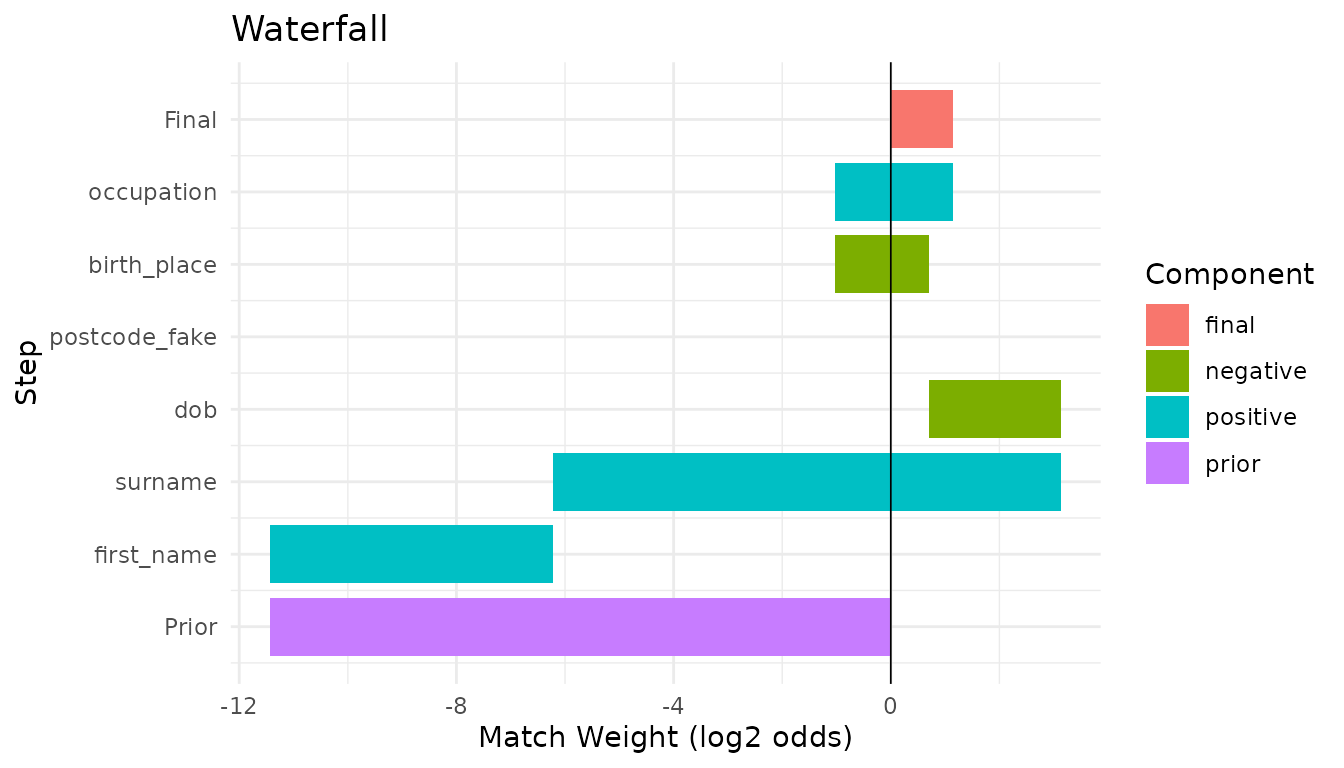
Cluster
clusters <- il_cluster(predictions, threshold = 0.95)
clusters
#> # A tibble: 46,088 × 2
#>    unique_id   cluster_id
#>    <chr>       <chr>
#>  1 Q538191-4   cluster_Q538191-1
#>  2 Q98759353-3 cluster_Q98759353-1
#>  3 Q5485995-5  cluster_Q5485995-1
#>  4 Q21453621-3 cluster_Q21453621-1
#>  5 Q7534311-2  cluster_Q7534311-1
#>  6 Q799510-9   cluster_Q799510-1
#>  7 Q426590-6   cluster_Q426590-1
#>  8 Q7659916-5  cluster_Q7659916-1
#>  9 Q18730184-7 cluster_Q18730184-1
#> 10 Q212085-3   cluster_Q212085-1
#> # ℹ 46,078 more rows
Evaluate against ground truth
acc <- il_accuracy(model, labels_col = 'cluster')
acc
#> # A tibble: 3,526 × 16
#>     threshold     tp     fp     fn    tn fn_blocking_miss precision recall    f1
#>         <dbl>  <int>  <int>  <int> <int>            <int>     <dbl>  <dbl> <dbl>
#>  1    0       203544 247197 100417     0           100417     0.452  0.670 0.539
#>  2    6.14e-9 203544 247197 100417     0           100417     0.452  0.670 0.539
#>  3    3.51e-8 203544 247157 100417    40           100417     0.452  0.670 0.539
#>  4    5.66e-8 203544 247114 100417    83           100417     0.452  0.670 0.539
#>  5    9.24e-8 203544 246732 100417   465           100417     0.452  0.670 0.540
#>  6    9.28e-8 203544 246731 100417   466           100417     0.452  0.670 0.540
#>  7    1.19e-7 203544 246731 100417   466           100417     0.452  0.670 0.540
#>  8    1.21e-7 203544 246701 100417   496           100417     0.452  0.670 0.540
#>  9    1.99e-7 203544 246652 100417   545           100417     0.452  0.670 0.540
#> 10    3.24e-7 203544 246591 100417   606           100417     0.452  0.670 0.540
#> # ℹ 3,516 more rows
#> # ℹ 7 more variables: f2 <dbl>, f0_5 <dbl>, specificity <dbl>, npv <dbl>,
#> #   accuracy <dbl>, p4 <dbl>, phi <dbl>
When you use labels_col, the evaluation derives all true
duplicate pairs from the ground-truth cluster column. Some true pairs
may never be generated by the blocking rules. Those pairs count as false
negatives at every threshold. As a result, the maximum recall in the
accuracy, ROC, and precision-recall plots is the blocking recall:
acc0 <- acc[acc$threshold == min(acc$threshold), ]
acc0$tp / (acc0$tp + acc0$fn)
#> [1] 0.6696385
autoplot(acc)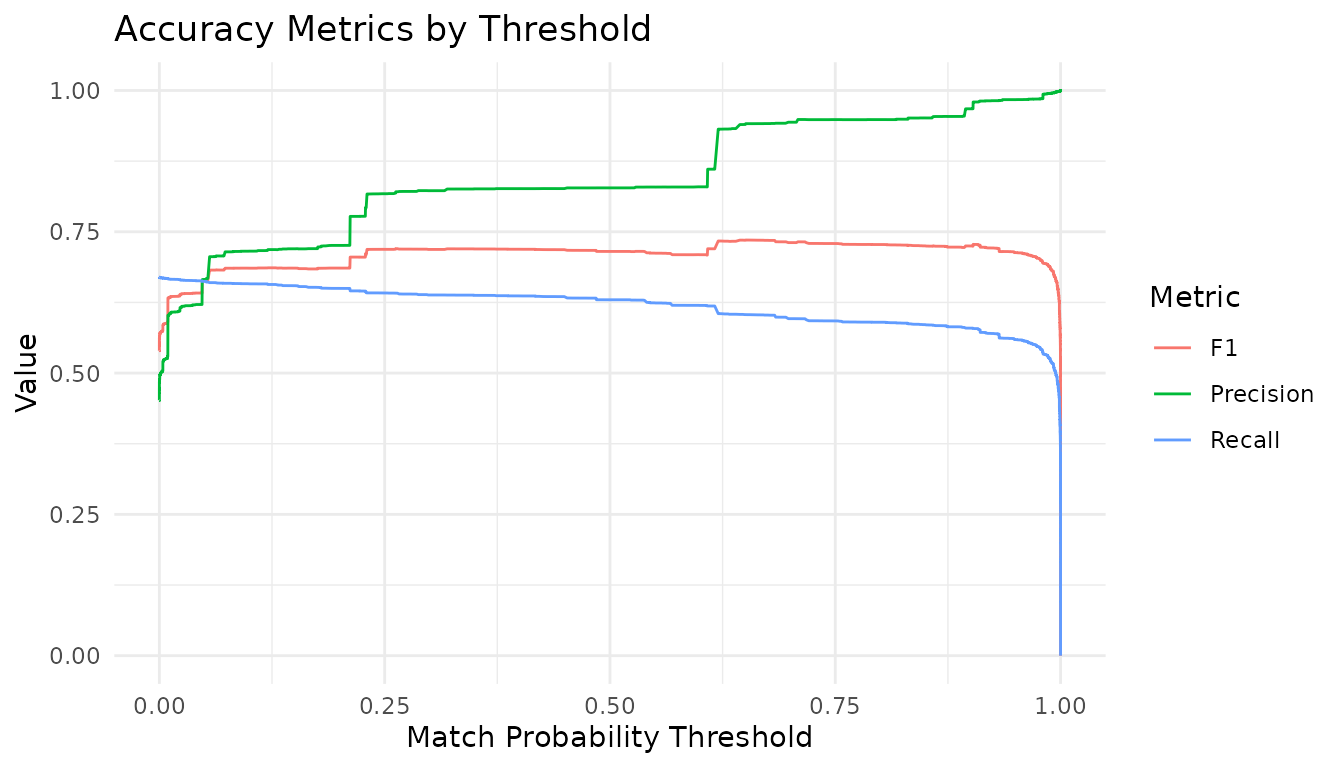
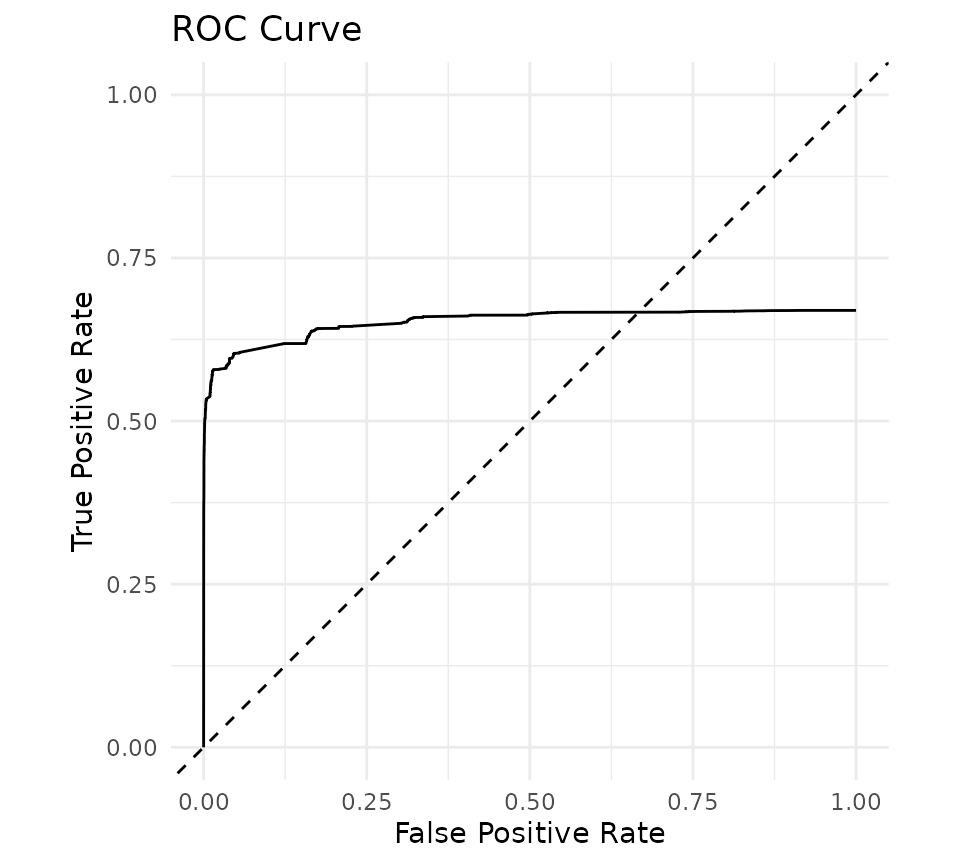
autoplot(il_precision_recall(model, labels_col = 'cluster'))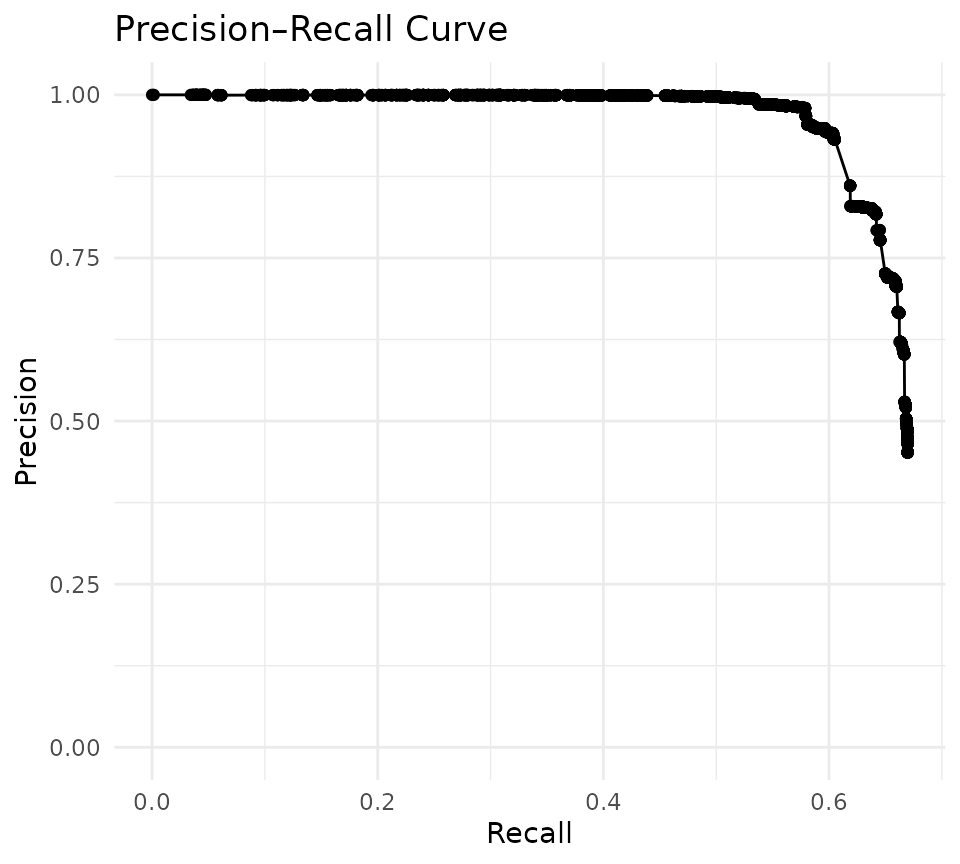
Error inspection
errors <- il_errors(model, labels_col = 'cluster', threshold = 0.999)
errors[errors$error_type == 'false_positive', ]
#> # A tibble: 368 × 6
#>    unique_id_l  unique_id_r match_weight match_probability true_label error_type
#>    <chr>        <chr>              <dbl>             <dbl> <lgl>      <chr>
#>  1 Q3568485-2   Q3568487-2          43.5             1.000 FALSE      false_pos…
#>  2 Q15176618-8  Q8005070-4          25.2             1.000 FALSE      false_pos…
#>  3 Q15176618-6  Q8005070-2          25.3             1.000 FALSE      false_pos…
#>  4 Q7528045-2   Q7528085-8          22.2             0.999 FALSE      false_pos…
#>  5 Q7528045-2   Q7528085-6          22.2             0.999 FALSE      false_pos…
#>  6 Q4088004-5   Q545038-3           24.9             1.000 FALSE      false_pos…
#>  7 Q17627000-2  Q24845632-1         23.9             1.000 FALSE      false_pos…
#>  8 Q3568485-5   Q3568487-2          44.7             1.000 FALSE      false_pos…
#>  9 Q7528045-2   Q7528085-3          22.2             0.999 FALSE      false_pos…
#> 10 Q16931677-18 Q7527919-5          22.6             0.999 FALSE      false_pos…
#> # ℹ 358 more rows
Some false negatives occur because the true pair was never generated by any blocking rule:
errors <- il_errors(model, labels_col = 'cluster', threshold = 0.5)
errors[errors$error_type == 'false_negative', ]
#> # A tibble: 112,363 × 6
#>    unique_id_l  unique_id_r match_weight match_probability true_label error_type
#>    <chr>        <chr>              <dbl>             <dbl> <lgl>      <chr>
#>  1 Q6227471-13  Q6227471-19        11.0          0.317     TRUE       false_neg…
#>  2 Q56562415-1  Q56562415-3        10.6          0.260     TRUE       false_neg…
#>  3 Q386694-12   Q386694-18          5.58         0.0105    TRUE       false_neg…
#>  4 Q19660947-12 Q19660947-9        10.6          0.260     TRUE       false_neg…
#>  5 Q5311987-13  Q5311987-3          7.29         0.0335    TRUE       false_neg…
#>  6 Q47486968-10 Q47486968-5         8.81         0.0904    TRUE       false_neg…
#>  7 Q16030077-16 Q16030077-9        10.2          0.208     TRUE       false_neg…
#>  8 Q5722403-13  Q5722403-8         -3.12         0.0000254 TRUE       false_neg…
#>  9 Q60519923-4  Q60519923-5        11.9          0.452     TRUE       false_neg…
#> 10 Q76042843-15 Q76042843-8        10.4          0.230     TRUE       false_neg…
#> # ℹ 112,353 more rows
Cleanup
il_cleanup(model)
DBI::dbDisconnect(con, shutdown = TRUE)
il_cleanup(model) is model-scoped. If an interactive run
failed before you kept the model object, call
il_cleanup_all(con) to remove all irelink
tables from the connection before disconnecting.